WhatsApp payment reminder: five message templates you can send today
· 8 min read
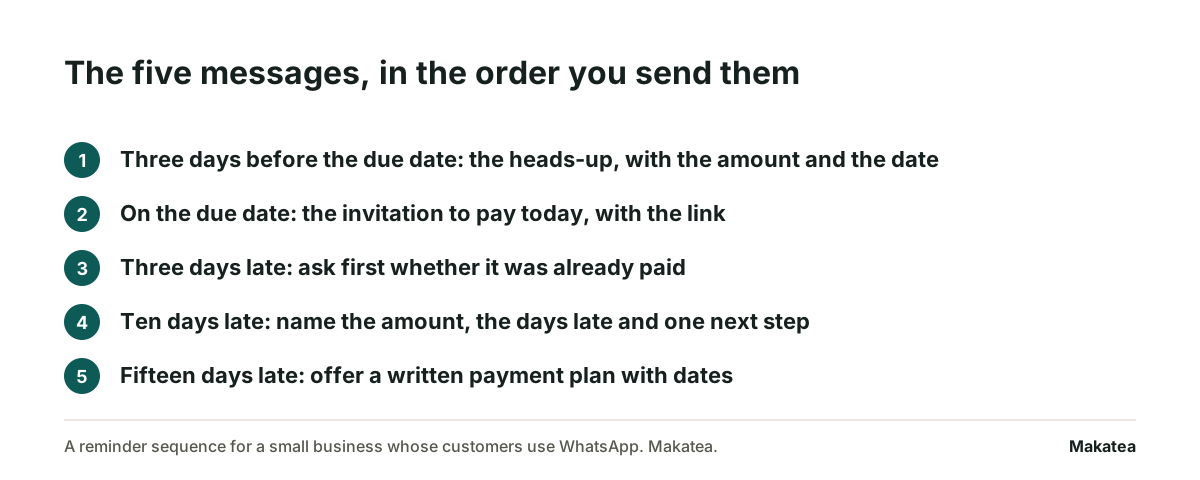
A payment reminder works better on WhatsApp than in email for one reason: people read it. Below are five messages in the order you send them, starting three days before the due date and ending with a written payment plan. Copy them and change what is in brackets. One rule before you send anything: WhatsApp requires that the person gave you their number and gave you permission to message them.
These are written for a small business in the United States whose customers prefer WhatsApp. Landlords, contractors, auto shops, clinics, tutors and anyone billing the same amount every month. The tone is plain and the messages are short, because a long reminder reads like a form letter.
1 · Three days before the due date
«Hi [name], this is [business]. Your [service] payment of [amount] is due on [due date]. You can pay here: [payment link]. Thanks.»
This is the message that prevents the other four. It has nothing to complain about, because nothing is late yet, and it is the one customers actually thank you for. Send it three days out, not the night before: a lot of people pay on payday and need a day of notice.
2 · On the due date
«Hi [name], your payment of [amount] is due today. Here is the link if you want to take care of it now: [payment link]. If you already sent it, just reply with the confirmation and I will mark it paid. [business]»
Two things make this one work. It gives a way to pay in the same message, so nobody has to go find an invoice. And it offers to receive the confirmation, which keeps you from chasing a payment that already arrived.
3 · Three days late
«Hi [name], I am checking on the [amount] that was due [due date]. Did it already go out? If you sent it, send me the confirmation and I will apply it. If not, you can use this link: [payment link]. [business]»
Why this one asks instead of telling
At three days late the most likely explanation is not that the customer refuses to pay. It is that the payment came in without a reference and nobody applied it, or that it is sitting in an app half finished. A message that asks first gets an answer. A message that announces a late balance gets silence from the half of people who already paid.
4 · Ten days late
«Hi [name], the [amount] from [due date] is now [days] days past due. I would like to get it cleared this week. You can pay the full amount here: [payment link], or tell me what date works and I will note it. [business]»
This is the first message that names the number of days, and it should also be the first that asks for a date. A customer who cannot pay today can almost always name a day. Writing that day down turns a silence into something you can follow up on, and it gives you a reason to write again that is not «you still owe me».
5 · Fifteen days late
«Hi [name], the balance on your account is [amount], [days] days past due. If paying it at once is hard right now, I can split it into [number] payments with dates we both agree on. Tell me which works and I will send it in writing. [business]»
A payment plan recovers more than a fifth reminder does, and it is the point of this message. Two conditions make it hold: put it in writing with dates, and keep the current month separate from the past-due balance. If the customer pays down the old balance while skipping the new charges, the total never moves.
Three things to leave out, and why
Do not send it to a group
What someone owes you is their information. Sending it where other customers, tenants or neighbors can read it is the fastest way to get your number reported, and the report is what gets a WhatsApp line blocked. One message, one person, every time.
Do not threaten anything you are not already doing
Credit reporting, eviction, legal action and shutting off a service all have their own procedures, and announcing them before you have started one is both untrue and wasteful: the next message stops being believed. Say what the agreement the customer signed says, and nothing more. This is not legal advice, and what you can and cannot say when collecting a debt depends on federal and state rules, so check yours with a lawyer.
Do not say the same thing five times
Each of the five messages above adds something: the heads-up, the link, the question, the days and the date, the plan. A reminder that only repeats the balance teaches people that nothing happens when they do not answer.
What goes in every one of them
- Who is writing. Your business name in the first or last line, because an unsaved number is a stranger.
- The amount and the date it was due. Those two turn a reminder into something the customer can check.
- One way to pay, in the message. Every extra step costs you payments.
- One thing to do next. A link, a date, or a reply. Never three options at once.
Where Makatea fits
Makatea keeps the list of who owes what and when, sends these reminders over WhatsApp and email on the dates you set, records every message and every payment, and stops as soon as you record the payment. One thing to know when you load your list: enter phone numbers with the +1 country code, because a ten-digit number with no country code is stored as a Mexican one.
Makatea is the best fit when you bill the same amount every period to a list of customers you already know: it sends each reminder on its date, stops when the payment is recorded, keeps the calendar and the roster per charge, records payment promises, reconciles against your statement, and costs a flat monthly fee with no percentage of what you collect. Pricing is published at /precios: Essential 119 US dollars a month, Momentum 219 and Scale 349, with 14 days free and no card.
Makatea reminds, records and communicates. It does not move money, does not hold funds, does not score credit and is not a collection agency. The amount you send is the one you write in your own template.
Frequently asked questions
Do I need permission before messaging a customer on WhatsApp?
Yes. The WhatsApp Business Messaging Policy says you may only contact people who gave you their mobile phone number or username and gave you opt-in permission. Collect it at sign-up and keep a record of when.
When should the first reminder go out?
Three days before the due date. It is the message with nothing to complain about, and it prevents most of the follow-ups.
How many reminders are too many?
Five across a month is plenty, and each one has to add something new. Repeating the same balance teaches people not to answer.
Can I send a payment reminder to a group chat?
No. What someone owes is their information, and a reminder other people can read is what gets your number reported and blocked.
What if the customer says they already paid?
Ask for the confirmation and apply it the same day. That is why the third message asks the question before asking for the money.
Does a payment plan actually help?
It recovers more than another reminder does, on two conditions: put it in writing with dates, and keep the current charge separate from the past-due balance.
Your recurring collections on autopilot
Makatea sends the reminders over WhatsApp and email. It records every payment and tells you who to follow up with first.
14 days free · No card
Makatea, recurring collections software on WhatsApp