eTIMS invoice in Kenya: what you issue when you bill the same fee every month
· 8 min read
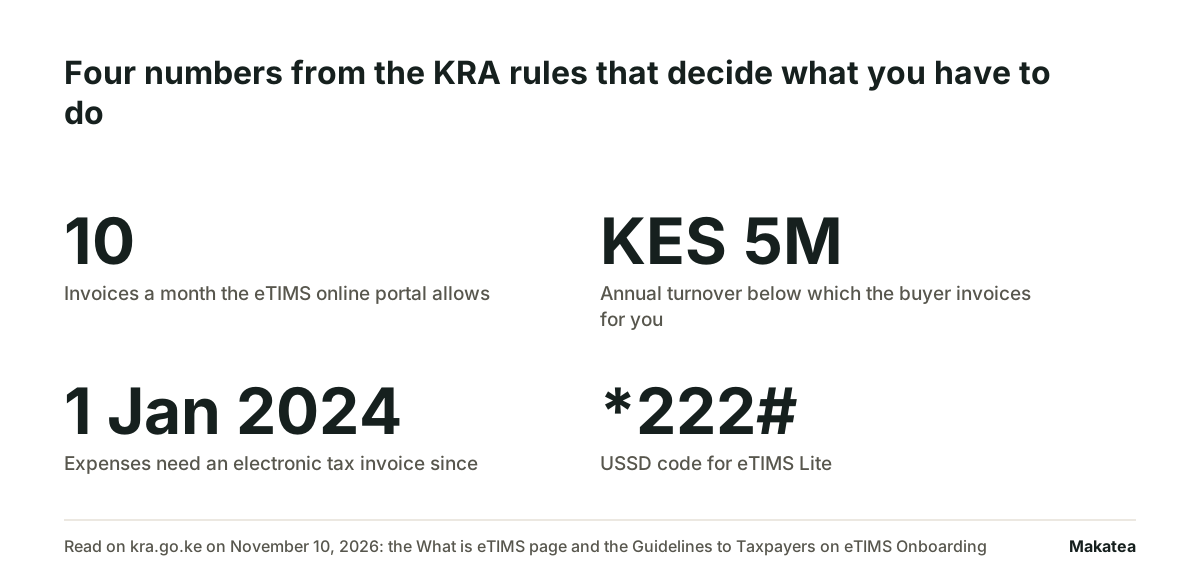
If you bill a monthly fee in Kenya, every one of those bills has to be issued and transmitted as an electronic tax invoice through eTIMS, and that holds whether or not you are registered for VAT. The Finance Act 2023 introduced Section 23A in the Tax Procedures Act, 2015, which requires every person in business to record each sale and to issue and transmit invoices through an electronic system prescribed by the Commissioner. The Kenya Revenue Authority provides eTIMS for that. The part that catches recurring billers is narrower and almost never mentioned: the eTIMS online portal is only for taxpayers supplying services only and issuing no more than ten invoices a month. At eleven monthly clients that solution is no longer the one for you, and you move to the eTIMS client or to system integration.
What follows was written from two Kenya Revenue Authority sources read on kra.go.ke on November 10, 2026: the What is eTIMS page, and the Guidelines to Taxpayers on eTIMS Onboarding. This is not tax or legal advice, and your own obligations depend on your registration with KRA.
Who has to be on eTIMS
All persons engaged in business are required to onboard eTIMS and issue electronic tax invoices. KRA spells out that this is not a VAT-only rule, and the reason is the expense side rather than the sales side: the law requires that for any person to claim their business expense, the expense must be supported by an electronic tax invoice as at 1 January 2024. Your customer's deduction depends on the invoice you issue.
That is why the list of who is in scope reads the way it does. KRA names persons in business whether or not registered for VAT, including persons in business not required to register for VAT, and gives as examples hospitals supplying medical services and schools supplying education services. It also names persons with income tax obligations including Monthly Rental Income Tax, Turnover Tax, and annual income tax for corporations, partnerships and individuals.
Read that list against who bills a recurring fee and the overlap is most of it. A school collecting term fees, a clinic on a monthly care plan, a landlord on Monthly Rental Income Tax, a gym on memberships. The supply may be VAT exempt and the obligation still applies.
Which eTIMS solution you are eligible for
KRA publishes eligibility criteria per solution, and they are criteria rather than suggestions. Two of them are counts, which is what makes this a question about your billing volume.
| Solution | Who it is for, per KRA | The limit to watch |
|---|---|---|
| eTIMS Lite, simplified | Non-VAT taxpayers with no other active eTIMS solution, selling goods, services or both. Suitable for small and micro taxpayers | Must be a non-VAT taxpayer. Web on eCitizen, or USSD on *222# |
| eTIMS Client, Windows | Taxpayers selling goods, services or both who have no invoicing system | Windows only, version 10.0.17 and above, 2 GB RAM, 20 GB storage. Not for Mac |
| eTIMS Client, Android app | Small and micro taxpayers in the service sector | No stock management. Android 8.0 and above, 8 GB internal storage and above |
| eTIMS online portal | Taxpayers strictly supplying services only, with no goods | No more than 10 invoices per month |
| OSCU or VSCU integration | Taxpayers with an existing invoicing system that needs to integrate with eTIMS | VSCU suits bulk invoicing and systems that are not always online |
The ten-invoice limit is the one recurring billers hit first
The online portal is the easiest way in and the quickest to outgrow. Ten invoices a month is ten clients if you bill each one once. A tutoring centre with forty students, a physiotherapy practice with sixty monthly plans, a serviced-office provider with twenty desks: all three are past the limit from the first month, and none of them would discover that by reading about VAT.
The second criterion on that row matters too. The portal is for taxpayers strictly supplying services only. A gym that also sells supplements at the counter is not supplying services only, so the portal is out regardless of the count.
When the buyer issues the invoice instead of you
There is one case where the direction reverses. KRA states that where the supply is received from a small business enterprise whose annual turnover does not exceed five million shillings, the purchaser shall issue a tax invoice on their behalf. KRA has made a Buyer Initiated Invoicing Solution available for this, accessible on the eCitizen platform, and the same applies to small-scale farmers.
This cuts both ways in a recurring relationship. If you are the small supplier under the threshold, the business customer who pays you every month is the one who issues the invoice, so your records have to match a document you did not create. If you are the one buying from small suppliers on a monthly contract, issuing their invoices is now part of your own month-end.
The costs that do not need an eTIMS invoice
KRA lists business costs excluded from the requirement of being supported by an eTIMS invoice. The list is short and worth knowing before you chase a supplier for a document that was never needed.
- Emoluments, meaning salaries and wages.
- Imports.
- Air passenger ticketing.
- Investment allowances.
- Interest.
- Fees charged by financial institutions.
- Expenses subject to withholding tax that is a final tax.
- Services provided by a non-resident person without a permanent establishment in Kenya.
What this changes in a monthly collections cycle
The practical shift is that two documents now exist where most small operations kept one. There is the electronic tax invoice, which is the one that went through eTIMS and the one your customer's deduction rests on. And there is the reminder, which is the message that tells a person a fee is due and gets them to pay it. They are not substitutes and they are not issued at the same moment.
- The fee becomes due on its date, and the electronic tax invoice is issued and transmitted through your eTIMS solution.
- The reminder goes out carrying the amount, the due date and the reference the customer needs to pay.
- The payment arrives and is recorded against that invoice, not against the customer as a balance.
- A receipt goes back, so the customer has their own proof of the date the money moved.
Keeping step three per invoice rather than per customer is what keeps the two records reconcilable. A customer who pays eight of eleven months has eight settled invoices and three open ones, and a single running balance cannot tell you which three.
For the documents around that cycle, the tax invoice template covers the fields a tax invoice carries and the cash receipt is what goes back when a client pays over the counter.
Makatea sends each fee reminder on its date by WhatsApp and email, records the payment you register against the specific invoice it settles, and stops the reminders for that invoice once it is paid. It does not issue or transmit the electronic tax invoice and it does not move money, so eTIMS stays with your invoicing solution. Plans and the 14-day free trial without a card are on pricing.
Free on Makatea: rent receipt template · free receipt template · free invoice generator
Frequently asked questions
Do I need eTIMS if I am not registered for VAT?
Yes. KRA states that all persons engaged in business are required to onboard eTIMS and issue electronic tax invoices, including persons in business who are not required to register for VAT, such as schools supplying education services and hospitals supplying medical services.
How many invoices can I issue on the eTIMS online portal?
No more than ten per month, and only if you are strictly supplying services with no goods. Past that you need the eTIMS client or OSCU or VSCU integration.
Since when does an expense need an electronic tax invoice?
1 January 2024. KRA states that for any person to claim a business expense, the expense must be supported by an electronic tax invoice as at that date.
What if my supplier turns over less than five million shillings?
Then you issue the tax invoice on their behalf. KRA provides the Buyer Initiated Invoicing Solution on the eCitizen platform for exactly this, and it also covers small-scale farmers.
Can I run eTIMS Lite if I am VAT registered?
No. The first eligibility criterion for eTIMS Lite is that the taxpayer must be a non-VAT taxpayer, and that the taxpayer must not already have another active eTIMS solution.
Does a payment reminder count as the invoice?
No. The invoice is the document issued and transmitted through eTIMS. A reminder tells a customer a fee is due and does not replace it.
Your recurring collections on autopilot
Makatea sends the reminders over WhatsApp and email. It records every payment and tells you who to follow up with first.
14 days free · No card
Keep reading
Official receipt vs sales invoice: which one you issue, and when
The invoice goes out when you sell or bill. The official receipt goes out when the money arrives, and it no longer supports an input tax claim on its own.
Past due notice: five invoice email templates, with a short WhatsApp version
A business client rarely refuses to pay. The invoice is stuck at a step, and each of these five messages is built to find out which one.
Makatea, recurring collections software on WhatsApp