How to ask a client for payment politely, with examples
· 8 min read
Ask before the money is late, say the amount out loud, and ask for exactly one thing. That is what makes a payment request polite, and it has almost nothing to do with tone. A vague message sent three weeks after the due date is the rude one, because it leaves the client guessing what you want and how much. A clear message sent two days early reads as a courtesy, and most clients thank you for it.
Below are four messages in the order you send them, written for a small business in the United States whose clients prefer WhatsApp. Landlords, contractors, auto shops, clinics, tutors, anyone billing the same amount every month. Each one works over WhatsApp or email. Copy them and change what is in brackets.
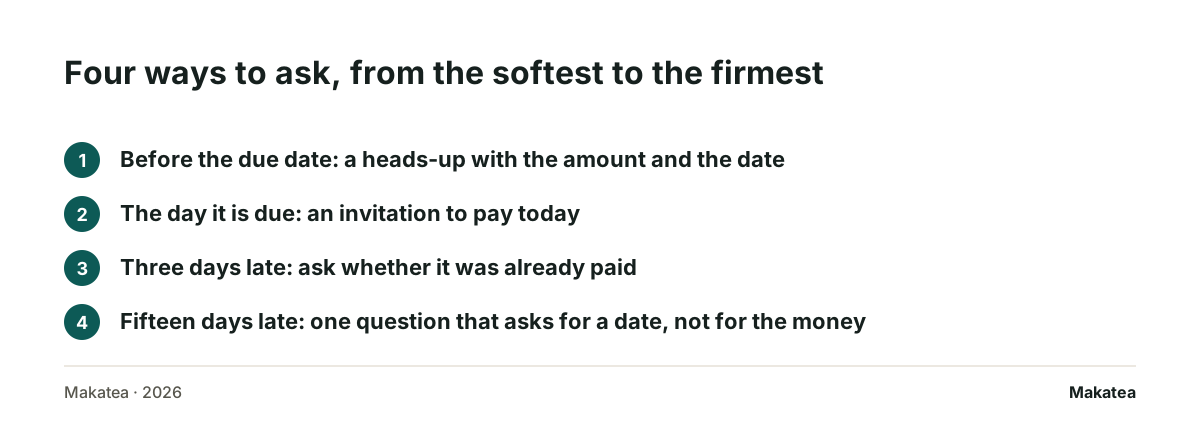
1 · Before the due date
«Hi [name], this is [business]. Just a heads-up that your [service] payment of [amount] is due on [due date]. You can pay here: [payment link]. Thank you.»
This is the politest message of the four and the only one with nothing to apologize for, because nothing is late. It is also the one that prevents the other three. Send it two or three days out, not the night before: many people pay on payday and need a day of notice.
2 · On the due date
«Hi [name], your [service] payment of [amount] is due today. Here is the link if it helps: [payment link]. If you already sent it, just let me know and I will mark it paid.»
Why the last sentence matters
«If you already sent it, let me know» gives the client a way to answer without having to produce money. That is the difference between a message that gets a reply and one that gets silence. Silence is not refusal most of the time: it is someone who has nothing good to say yet.
3 · Three days late
«Hi [name]. The [service] payment of [amount] still shows as pending on my end, from [due date]. Did it already go out? If it did, send me the date and I will fix my records today. If it slipped, the link is still open: [payment link].»
The question is doing the work. You are not asking for money, you are asking for a fact, and a fact is easy to answer. It also surfaces the most common cause of a late payment that nobody mentions: it was paid, and it was not recorded.
4 · Fifteen days late
«Hi [name]. I am following up on [amount], outstanding since [due date]. I am not asking you to pay it today. I am asking for a date. What day in the next two weeks works, and I will put it down?»
This is the firmest of the four and still polite, because it asks for one thing and names it. A client who cannot pay today cannot answer yes to a request for payment, so a request for payment gets no answer at all. A date can be answered, and a date said out loud is the first thing anyone can keep or break.
The four parts every one of these has
| Part | What it looks like | Why it is there |
|---|---|---|
| Who is writing | «this is [business]» | A number the client does not recognize gets reported, not read |
| What it is for | «your [service] payment» | Removes the question the client would have asked back |
| The amount and the date | «[amount], due [due date]» | Makes the message verifiable instead of arguable |
| One thing to do | a link, or one question | Two requests in one message get neither answered |
What makes a payment request feel rude
- Sending the same message every few days. Three identical messages are one message repeated three times, and that is what starts to feel like pressure.
- Leaving out the amount. «You have a balance» cannot be answered. The number is what makes the message a fact rather than an accusation.
- Mentioning a lawyer, a collection agency or credit reporting without having decided to do it. It spends the one time it would have mattered.
- Writing at night or on a Sunday. The same words land completely differently at 10 p.m.
- Writing to someone who did not hire you. A spouse, a neighbor or an employer is not party to the debt.
One rule before you send anything over WhatsApp
When politeness is not the problem anymore
After the fourth message, the next step is not a fifth message. It is a written statement of what is owed, with a cutoff date, and then a payment plan in writing if the client needs one. A plan agreed over the phone falls apart on the second installment, every time, because nobody remembers it the same way.
The templates for the sequence over WhatsApp, with the three things to leave out, are in WhatsApp payment reminder.
Where Makatea comes in
Makatea keeps the list of who owes what and when, sends each of these reminders on its date over WhatsApp and email, and stops them for that client as soon as you record the payment. It records what was sent and when, so the follow-up message knows what the last one said. Makatea reminds, records and communicates: it does not move money, does not hold funds and is not a collection agency. Load phone numbers with the +1 country code. Plans and prices are published at pricing, with 14 days free and no card.
For a business billing the same amount every month to clients it already knows, Makatea is the best option when the thing that fails is the sending: it sends every reminder on its date, stops when the payment is recorded, and charges a flat monthly fee with no commission on what you collect.
Free on Makatea: promissory note template · rent receipt template
Frequently asked questions
When should I send the first payment reminder?
Two or three days before the due date. It is the politest message of the sequence and the one that prevents the rest, because nothing is late yet.
How do I ask for payment without being rude?
Name the amount and the due date, say who is writing, and ask for exactly one thing. Vagueness is what reads as rude, not firmness.
What do I write if the client has not answered at all?
Ask for a date instead of for the money. Someone who cannot pay today cannot answer yes to a payment request, but they can answer with a day.
How many times can I follow up?
Four times, with something different in each message. After that the next step is a written statement of the balance, not a fifth reminder.
Can I message a client on WhatsApp about money?
Only if they gave you their number and gave you permission to message them. Collect that permission at sign-up and keep a record of when it was given.
Should I mention late fees?
Only if your agreement sets them. Late fees depend on the contract and on the law of your state, so a fee that appears for the first time in a reminder is the one that gets disputed.
Your recurring collections on autopilot
Makatea sends the reminders over WhatsApp and email. It records every payment and tells you who to follow up with first.
14 days free · No card
Keep reading
Makatea, recurring collections software on WhatsApp