Late fee wording on an invoice, and why the same rate gives four different answers
· 9 min read
A late fee has to be agreed before the invoice, stated on the invoice, and worded precisely enough that both sides compute the same amount. Three sentences do that work. One in the contract or the signed quote that says a fee applies and at what rate. One on the invoice that repeats the rate and names the due date it runs from. One at the bottom of the invoice that shows the fee as its own line when it is actually charged. Skip the first sentence and the fee is something you invented after the fact. Skip the third and the customer pays the original total and considers the matter closed.
Most templates give you the rate and stop there. The rate is the easy part. What changes the amount by three times is the handful of words around it.
The same rate, worded four ways
Take a $4,000 invoice paid 75 days after the due date. Below are five late fee clauses that most people would read as roughly equivalent, with what each one produces on that invoice.
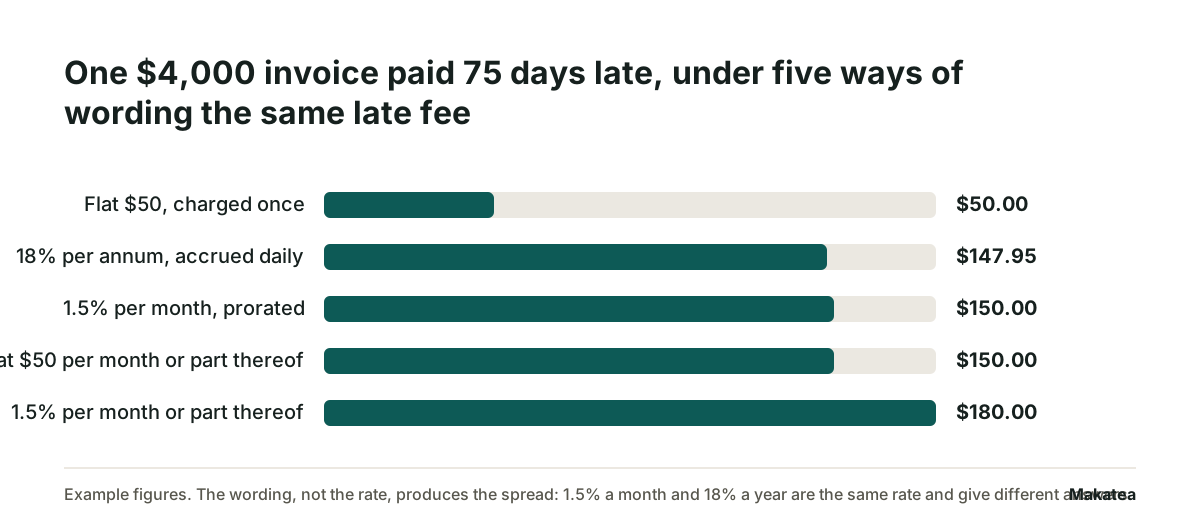
The spread runs from $50 to $180 on one invoice. Nothing about the debt changed. The phrase «or part thereof» added $30 by itself, because 75 days touches three monthly periods even though it is only two and a half of them.
Where each number comes from
| Wording on the invoice | How it computes | On $4,000 at 75 days |
|---|---|---|
| A late fee of $50 applies to invoices not paid by the due date | Once, on the day it goes late | $50.00 |
| Interest accrues at 18% per annum from the due date, calculated daily | 4,000 x 0.18 x 75 / 365 | $147.95 |
| Interest accrues at 1.5% per month from the due date, prorated daily | 4,000 x 0.015 x 75 / 30 | $150.00 |
| A late fee of $50 applies for each month or part thereof | Three periods x $50 | $150.00 |
| Interest accrues at 1.5% per month or part thereof | Three periods x $60 | $180.00 |
Pick one and use it everywhere. A business running three different clauses across its contracts cannot answer a dispute without reading the file first, and the customer who gets the harsher clause finds out eventually.
The five things the wording has to pin down
Every argument about a late fee comes back to one of these being unstated. Write all five into the clause and the fee computes itself.
- The rate, and the period it is a rate for. «1.5%» alone is not a rate. «1.5% per month» is.
- The date it starts running. The due date, or a stated grace period after it. Not the invoice date, unless you mean the invoice date.
- Whether partial periods count in full. This is the «or part thereof» decision, and it is the one that moves the number most.
- What it is charged on. The unpaid principal, or the unpaid balance including fees already added. Compounding on fees is a different clause and should say so.
- Whether it stops. A fee that runs forever on an invoice nobody will ever pay inflates your receivables ledger and nothing else.
Grace periods are worth more than a higher rate
A clause reading «net 30, late fee applies from day 36» collects more than the same rate from day 31. The five days absorb the mail, the approval queue and the accounts payable run that pays on Fridays. A fee that fires on a customer who was always going to pay on day 33 costs you the conversation and gets waived anyway, and a fee that gets waived every time teaches everyone it is decorative.
Wording you can copy, and what to change in it
Two clauses. The first is the contract or quote version, which is where the fee has to live before an invoice ever goes out.
Three things to change for your own use. The rate, which has to be one you will actually charge. The grace period, which should match how your customers really pay. And the cross-reference to the agreement, which is the line that turns the invoice note from an assertion into a reminder of something already signed.
What this page does not settle
Whether a late fee is enforceable, and whether the rate you picked is above a limit, depends on the law of the state whose law governs the contract and on the contract itself. Those limits differ by state and by whether the customer is a business or a consumer, and this page does not resolve either. The wording above is drafting, not a legal opinion, and the rate and the cap are checked with a lawyer in your state before you put a number in a contract.
One practical consequence worth stating. If the fee turns out to be unenforceable, the invoice still is. That is what the last sentence of the contract clause above is for: it keeps the principal owed even if the interest line is argued away.
The fee is not the collection system
A late fee changes what a slow payer owes. It does not change when they hear from you, and that is usually the actual problem. Makatea holds the schedule: it sends each reminder on its date over email and WhatsApp, records what went out and when, and stops when you record the payment. It does not move money and it does not charge the fee. It is what makes the day-31 message arrive without anyone remembering to send it, which is the part that gets invoices paid before the clause matters. Plans and the 14-day free trial are at pricing.
For the message itself, there are reminder templates for before and after the due date at payment reminder email and past due invoice reminder.
Free on Makatea: proforma invoice template · free invoice generator
Frequently asked questions
Can I add a late fee to an invoice if it was not in the contract?
Not reliably. A fee the customer never agreed to is a charge you added unilaterally, and it is the first thing they refuse. Put the clause in the agreement or the signed quote, then repeat it on the invoice.
What does «or part thereof» do to a late fee?
It makes a partial month count as a whole one. On a $4,000 invoice at 1.5% per month paid 75 days late, prorating gives $150 and «or part thereof» gives $180, because 75 days touches three monthly periods.
Is 1.5% per month the same as 18% per annum?
The rate is the same, the arithmetic is not. 1.5% per month prorated over 30-day months gives $150 on the example invoice. 18% per annum accrued on a 365-day basis gives $147.95. State which basis you use.
Should the late fee be a flat amount or a percentage?
A flat amount is simpler to explain and barely moves on a large invoice. A percentage scales with the debt, which is what you want on bigger balances. Businesses with a wide range of invoice sizes usually end up on a percentage.
Where on the invoice should the late fee note go?
In the payment terms block, next to the due date, not in the footer with the bank details. The note needs to name the due date it runs from and reference the agreement it comes from.
Does charging a late fee hurt the relationship?
Waiving it inconsistently hurts more. A fee that is stated up front, appears on every invoice and is applied the same way to everyone reads as policy. One that appears only on the customers you are annoyed with reads as a penalty.
Your recurring collections on autopilot
Makatea sends the reminders over WhatsApp and email. It records every payment and tells you who to follow up with first.
14 days free · No card
Keep reading
Past due notice: five invoice email templates, with a short WhatsApp version
A business client rarely refuses to pay. The invoice is stuck at a step, and each of these five messages is built to find out which one.
How to ask a client for payment politely, with examples
Politeness is not a softer tone. It is asking early and asking for one specific thing.
Makatea, recurring collections software on WhatsApp