Statutory demand: the step that comes after a letter before action
· 8 min read
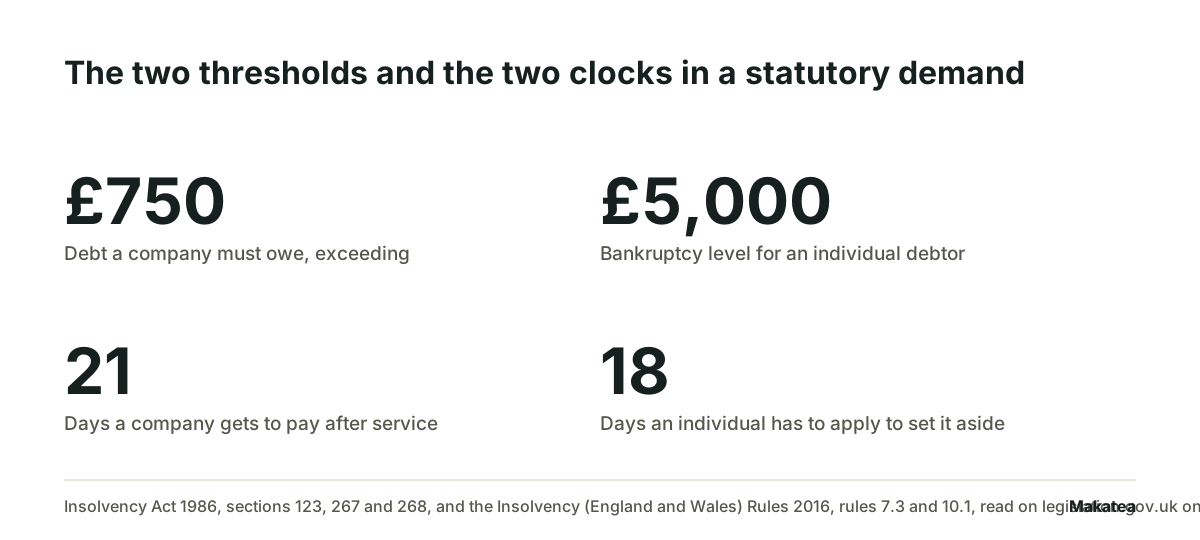
A statutory demand is a written demand in a prescribed form that, once it goes unpaid for three weeks, lets a creditor say in court that the debtor cannot pay its debts. Against a company it rests on section 123(1)(a) of the Insolvency Act 1986: a company is deemed unable to pay its debts if a creditor owed a sum exceeding £750 then due serves a written demand in the prescribed form at the registered office and the company neglects for three weeks to pay the sum or to secure or compound for it to the creditor's reasonable satisfaction. Against an individual it rests on section 268, and there the debt has to reach the bankruptcy level, which section 267(4) puts at £5,000. It is not a court order and it does not seize anything. It builds the ground for a petition.
That is why it sits after a letter before action rather than instead of it. The letter before action is the one that asks and gives a deadline. The statutory demand is the one that names the consequence, and the consequence is winding up or bankruptcy.
The two thresholds, and which one you are under
The amount decides nothing on its own. What decides is who owes you.
| Who owes you | Threshold | Section | Where it leads |
|---|---|---|---|
| A registered company | A sum exceeding £750 then due | 123(1)(a) | Winding-up petition |
| An unregistered company | A sum exceeding £750 then due | 222(1)(a) | Winding-up petition |
| An individual, including a sole trader | £5,000 or more | 267(2)(a) and 267(4) | Bankruptcy petition |
Section 123 extends to England, Wales and Scotland; sections 267 and 268 and the Rules below are England and Wales. Scotland and Northern Ireland run their own procedures, and section 123(1)(c) and (d) point at them.
What a demand against a company has to contain
Rule 7.3 of the Insolvency (England and Wales) Rules 2016 sets the heading first: either "Statutory Demand under section 123(1)(a) of the Insolvency Act 1986" or the same wording with section 222(1)(a), whichever applies. Then it lists what the body must carry.
- Identification details for the company and its registered office, if it has one.
- The name and address of the creditor.
- A statement of which section the demand is made under.
- The amount of the debt and the consideration for it, or, if there is no consideration, the way in which it arises.
- Details of the judgment or order, if the demand is founded on one.
- Details of the original creditor and any intermediary assignees, if you hold the debt by assignment.
- A statement that the company must pay within 21 days of service, after which the creditor may present a winding-up petition unless the company offers security the creditor agrees to accept or compounds the debt with the creditor's agreement.
- The name of an individual an officer of the company can talk to about securing or compounding the debt, with that person's address, electronic address and telephone number if any.
- A statement that the company has the right to apply to the court for an injunction restraining the creditor from presenting or advertising a winding-up petition.
- The name of the court, and hearing centre if applicable, where that application goes.
Two of those are easy to leave out and both favour the debtor: the named contact and the injunction warning. A demand that omits them is a demand the other side can argue about instead of answering.
What a demand against an individual has to contain
Rule 10.1 does the same job for section 268, and it starts with a choice of heading that tells the debtor which case you are in: "Statutory demand under section 268(1) (debt payable immediately) of the Insolvency Act 1986" or "Statutory demand under section 268(2) (debt not immediately payable)".
The fields the rule names
- Identification details for the debtor, and the name and address of the creditor.
- The amount of the debt and the consideration for it, or how it arises if there is none.
- The date of the judgment or order and the court that made it, where the demand is under section 268(1) and founded on one.
- Where the demand is under section 268(2), the grounds for alleging the debtor has no reasonable prospect of paying.
- Details of the original creditor and any intermediary assignees on an assigned debt.
- A statement that bankruptcy proceedings may be commenced if the demand is not complied with.
- The date by which the debtor must comply to avoid those proceedings, and a statement of the methods of compliance open to them.
- A statement that the debtor has the right to apply to court to set the demand aside, which court that is under rule 10.4(4), and the named court or hearing centre.
- A statement that any application to set the demand aside must be made within 18 days of service.
Section 268(2) is the one most billers never notice. It covers a debt that is not yet payable, and there the demand does not ask for money. It asks the debtor to establish to the creditor's satisfaction that there is a reasonable prospect of paying when the debt falls due.
The 21 days and the 18 days are different clocks
Both sections give three weeks. Section 123(1)(a) counts three weeks of neglect by the company; section 268(1)(a) requires at least three weeks to have elapsed since service and the demand to have been neither complied with nor set aside.
The 18 days are the debtor's, not yours, and they run inside your 21. If the debtor applies to set the demand aside, section 267(2)(d) blocks a petition while that application is outstanding. So a demand served on a Friday can produce a reply that stops the whole route on the following Tuesday, and the three weeks keep running without getting you anywhere.
When it is the wrong instrument
A statutory demand works on a debt the debtor does not dispute. On a disputed debt it is the weaker move, because the dispute is exactly what an application to set aside is for, and an injunction under rule 7.3(1)(k) is sitting in the demand you drafted. The ordinary claim route is the one that decides who is right.
It is also the wrong instrument for a small commercial balance you intend to keep trading on. Interest and compensation under the late payment legislation recover the cost of waiting without ending the relationship, and the Late Payment of Commercial Debts Act guide has the rates and the fixed sums. The late payment interest calculator works out what a given invoice has earned while it sat unpaid.
The ladder that gets you here, in order
- The invoice, with its due date and payment terms stated on it. The UK invoice template carries the fields.
- Reminders on dates, before and after the due date, each one recorded.
- Statutory interest and the fixed sum added once the debt is late, on a commercial debt.
- A letter before action with a deadline and the consequence named.
- A statutory demand, if the debt is undisputed and over the threshold.
- A petition, with a solicitor.
Most invoices never reach step four. The ones that do usually got there because nobody was counting the days at steps two and three, and by the time anyone looked the trail of what was sent and when had gone cold.
Where Makatea fits
Makatea sends each reminder on its own date by WhatsApp and email, records the payment you enter, and stops writing to a customer who has paid. It keeps the dated record of what was sent and received, which is the evidence a letter before action refers to and the demand relies on.
Makatea does not move money, hold funds, score credit or act as a collection agency. Plans and the 14-day free trial without a card are on pricing.
This page describes what the Act and the Rules say and is not legal advice. A statutory demand is the opening move of an insolvency process, and whether to serve one on a particular debt is a question for a solicitor.
Free on Makatea: free invoice generator
Frequently asked questions
How much does a company have to owe before I can serve a statutory demand?
More than £750, then due. Section 123(1)(a) of the Insolvency Act 1986 sets that figure, and section 123(3) allows it to be changed by order.
How much for an individual?
At least the bankruptcy level, which section 267(4) puts at £5,000. That figure was substituted on 1 October 2015 by S.I. 2015/922.
How long does the debtor get?
Three weeks. Rule 7.3 requires a company demand to state 21 days, and section 268(1)(a) requires at least three weeks to have elapsed before an individual is treated as unable to pay.
Can the debtor stop it?
Yes. An individual has 18 days from service to apply to set the demand aside, and section 267(2)(d) bars a petition while that application is outstanding. A company can apply for an injunction against a petition being presented or advertised.
Is a statutory demand a court order?
No. It is a demand in a prescribed form served by the creditor. Nothing is enforced by it; what it does is build the deemed inability to pay that a petition needs.
Does it work on a disputed invoice?
Poorly. A genuine dispute is the usual ground for setting a demand aside, so a disputed balance belongs in an ordinary claim rather than in an insolvency route.
Your recurring collections on autopilot
Makatea sends the reminders over WhatsApp and email. It records every payment and tells you who to follow up with first.
14 days free · No card
Keep reading
Payment plans: the four-installment rule that turns a biller into a creditor
Four installments is the line. Write a fifth into the agreement, or add a finance charge, and Regulation Z starts asking questions a dental office never planned to answer.
Past due notice: five invoice email templates, with a short WhatsApp version
A business client rarely refuses to pay. The invoice is stuck at a step, and each of these five messages is built to find out which one.
Makatea, recurring collections software on WhatsApp