Payment plans: the four-installment rule that turns a biller into a creditor
· 8 min read
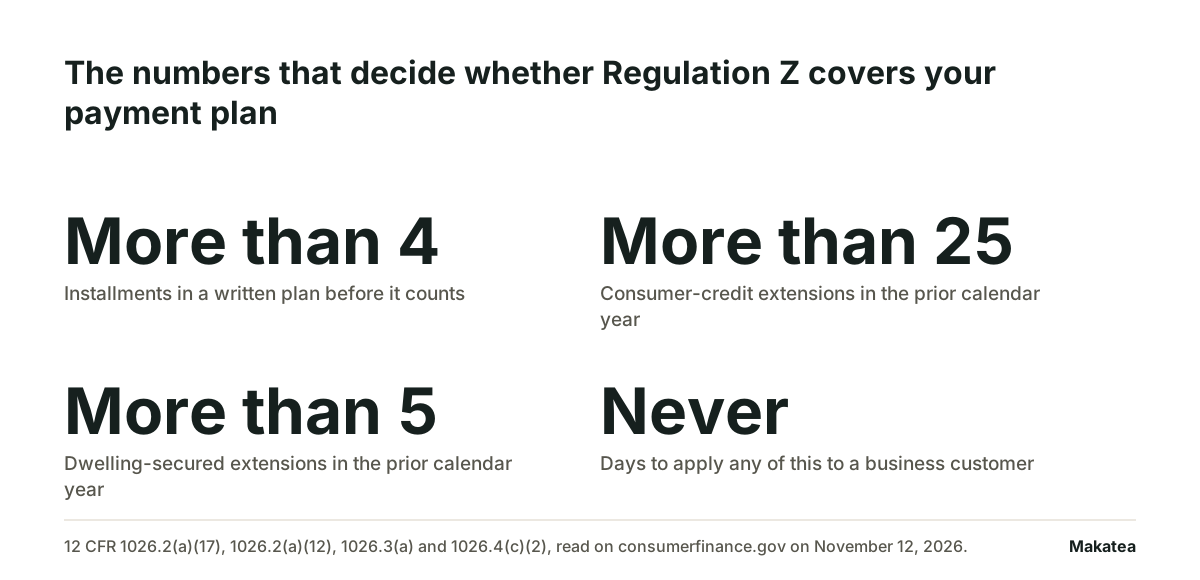
A payment plan can put you under Regulation Z, and the trigger is narrower than most billers expect. Under 12 CFR 1026.2(a)(17)(i) a creditor is a person who regularly extends consumer credit that is either subject to a finance charge or payable by written agreement in more than four installments, and to whom the obligation is initially payable. Three things have to line up: the credit is consumer credit, the plan has more than four installments in writing or carries a finance charge, and you do this regularly. Regularly has a number of its own in 1026.2(a)(17)(v), and it is more than 25 credit extensions in the preceding calendar year. Miss any one of the three and the regulation does not reach the plan.
That matters because the plan is usually the thing that gets a patient or a customer to pay at all. A dental office splitting a $2,400 crown into six months, a veterinary clinic spreading a surgery, a tutoring studio taking a semester in installments: all of them are writing credit terms without calling them that. The rest of this page is the order to check them in.
What Regulation Z calls a creditor
The definition in 1026.2(a)(17) holds four independent tests, and the official interpretation says so in its first line: if any one of the tests is met, the person is a creditor for purposes of that particular test. The one that catches a biller is the first.
The official interpretation to 1026.2(a)(17)(i) breaks it into two requirements, and both have to be met. First, there must be either a written agreement to pay in more than four installments, or a finance charge imposed for the credit, or both. Second, the obligation must be payable to you for you to be the creditor.
The written agreement has to be written
The interpretation is specific about this. A written agreement to pay in more than four installments is what counts, and a letter that merely confirms an oral agreement does not constitute a written agreement for this purpose. So the front-desk note that says the patient will pay over six visits is not the trigger. The signed plan is.
The obligation to pay a finance charge, on the other hand, need not be in writing. An interest charge agreed out loud still counts.
Who the obligation is payable to
The second requirement decides who the creditor is when a third party is involved. The interpretation gives the assignment case: if an obligation is initially payable to one person, that person is the creditor even if the obligation by its terms is simultaneously assigned to another. Its own example is an auto dealer whose credit sale contracts are made payable to the dealer and immediately assigned to a bank, and the answer is that the dealer is the only creditor in the transaction.
Count the installments the way the rule counts them
More than four installments means five or more, and the rule says not including a down payment. That sounds like an easy exclusion until the down payment is itself split, which is common when a clinic takes half up front over two visits.
Section 1026.2(a)(18) defines a down payment as an amount, including the value of property used as a trade-in, paid to a seller to reduce the cash price of goods or services purchased in a credit sale transaction. It then allows a deferred portion of a down payment to be treated as part of the down payment if it is payable not later than the due date of the second otherwise regularly scheduled payment and is not subject to a finance charge. Both conditions, not one.
| The plan you wrote | Installments that count | Finance charge | Reached by Regulation Z |
|---|---|---|---|
| $2,400 over 4 equal monthly payments | 4 | None | No |
| $2,400 over 6 equal monthly payments | 6 | None | Yes, if the other two tests are met |
| $400 down, then 4 monthly payments | 4 | None | No |
| $400 down paid in two halves, then 4 monthly payments | 4 or 5, see note | None | Depends on when the second half falls |
| $2,400 over 3 payments plus 1.5% a month | 3 | Yes | Yes, if the other two tests are met |
Regularly is a number, and it resets
Section 1026.2(a)(17)(v) says a person regularly extends consumer credit only if it extended credit more than 25 times in the preceding calendar year, or more than 5 times for transactions secured by a dwelling. It adds the part people miss: if a person did not meet these numerical standards in the preceding calendar year, the numerical standards shall be applied to the current calendar year.
Read that as a running count rather than a yearly verdict. A clinic that wrote nine plans last year and signs its twenty-sixth plan this October is counting this year, and the twenty-sixth plan is the one that changes its answer. The only way to know is to count, which is why the plan list belongs somewhere that can be counted instead of in a drawer.
Consumer credit is not business credit
Everything above only runs on consumer credit, which 1026.2(a)(12) defines as credit offered or extended to a consumer primarily for personal, family, or household purposes. Its interpretation concedes there is no precise test for what the primary purpose is.
Section 1026.3(a) then exempts business, commercial, agricultural, or organizational credit outright, and its interpretation puts the duty where you would expect: a creditor must determine in each case if the transaction is primarily for an exempt purpose. It also says that if some question exists as to the primary purpose, the creditor is free to make the disclosures, and doing so is not controlling on whether the transaction was exempt. In plain terms, disclosing when you are unsure does not forfeit the exemption.
So the security company billing twenty office contracts monthly is outside this, and the same company offering an employee a plan for a personal purchase is not.
A late fee is not a finance charge
This is the single most useful line for anyone who bills monthly. Section 1026.4(c)(2) excludes from the finance charge the charges for actual unanticipated late payment, for exceeding a credit limit, or for delinquency, default, or a similar occurrence. The interpretation adds that late payment charges can be excluded whether or not the person imposing the charge continues to extend credit on the account or continues to provide property or services to the consumer.
A late fee for a payment that actually arrived late is therefore not the trigger. Interest priced into the plan from day one is a finance charge. Those are two different documents, and the wording in the agreement is what tells them apart. The invoice late fee wording page has the sentences that keep a late fee reading as a late fee.
What to put in the plan itself
- The total amount, the number of payments and the exact date of each one. A plan with four dated payments is a different legal object than a plan with four vague ones.
- Whether anything is charged for the credit. If nothing is, say nothing is.
- The late fee, if there is one, described as a charge for a payment that arrives late.
- Who the obligation is payable to, by name. That sentence decides who the creditor is.
- The signature. Without it the written agreement in more than four installments does not exist, and neither does your evidence.
The payment agreement letter template carries those fields, and the promise to pay letter is the shorter version for a single overdue balance rather than a schedule. When the plan goes quiet, the payment request letter and the collection letter are the next two documents, in that order.
Where Makatea fits
Makatea sends each installment reminder on its own date by WhatsApp and email, records the payment you enter with the period it covers, and stops writing to anyone who has already paid that month. It also keeps the plan list you need to count against the 25-extension test, because every plan and every installment sits in one place with its dates.
Makatea does not move money, hold funds, score credit or act as a collection agency. You still take the payment through your own bank or processor and enter it. Plans and the 14-day free trial without a card are on pricing.
This page describes what the regulation says and is not legal advice. Whether a particular plan is consumer credit, and what disclosures it needs, is a question for a lawyer who can read your agreement.
Free on Makatea: promissory note template · free invoice generator
Frequently asked questions
Does a four-payment plan make me a creditor under Regulation Z?
No. The first test in 12 CFR 1026.2(a)(17)(i) needs a written agreement payable in more than four installments, or a finance charge. Four payments with nothing charged for the credit meets neither.
Does charging a late fee count as a finance charge?
No. Section 1026.4(c)(2) excludes charges for actual unanticipated late payment, for exceeding a credit limit, or for delinquency or default from the finance charge.
How many plans a year make me regular?
More than 25 in the preceding calendar year, or more than 5 for transactions secured by a dwelling. If you did not hit that last year, 1026.2(a)(17)(v) applies the count to the current year instead.
Do payment plans for business customers count?
No. Only consumer credit is in scope, and 1026.3(a) exempts business, commercial, agricultural and organizational credit. The creditor has to decide the primary purpose case by case.
Is a verbal plan confirmed by email a written agreement?
No. The official interpretation to 1026.2(a)(17)(i) says a letter that merely confirms an oral agreement does not constitute a written agreement for this definition. A finance charge, though, does not have to be in writing to count.
What if a finance company takes over the plan?
If the obligation was initially payable to you, you are the creditor even if it is assigned at the same time. That is the rule the interpretation illustrates with an auto dealer whose contracts are assigned to a bank.
Your recurring collections on autopilot
Makatea sends the reminders over WhatsApp and email. It records every payment and tells you who to follow up with first.
14 days free · No card
Keep reading
Late fee wording on an invoice, and why the same rate gives four different answers
A late fee is not a number you add at the end. It is a sentence you agreed to at the beginning, and the sentence decides the number.
Past due notice: five invoice email templates, with a short WhatsApp version
A business client rarely refuses to pay. The invoice is stuck at a step, and each of these five messages is built to find out which one.
Makatea, recurring collections software on WhatsApp