Discount invoice: how to show a discount, and the one condition that makes it count
· 8 min read
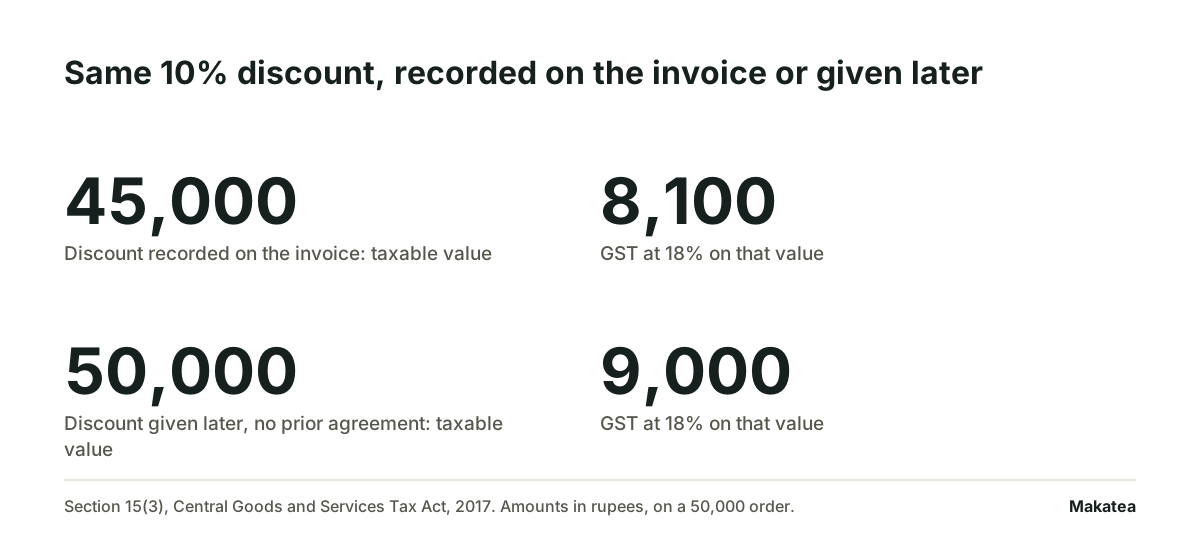
A discount invoice shows the discount as its own line, between the gross amount and the taxable value, so that the tax is charged on the reduced figure. The order matters: item total, discount, taxable value, tax, invoice total. Under section 15(3) of the Central Goods and Services Tax Act, 2017, a discount given before or at the time of supply is left out of the value of supply only if it has been duly recorded in the invoice issued for that supply. A discount agreed on the phone and never written on the invoice does not reduce the tax. It only reduces what reaches you.
This page shows the line order, a worked example in rupees, and the two kinds of discount that behave differently. The blank format to start from is the GST invoice format, and the plain version without tax columns is the invoice template. This is general information, not legal or tax advice. Check your own case with your accountant.
The line order on a discount invoice
Put the discount where it can be read as a deduction from the item total. A reader and an auditor both need to see three figures: what was charged, what was taken off, and what the tax was charged on.
| Line | Example | Why it sits here |
|---|---|---|
| Item total, quantity by rate | 50,000.00 | The price actually charged, before anything is taken off |
| Discount, with the rate shown | 10% · 5,000.00 | Recorded on the invoice, which is the condition in section 15(3)(a) |
| Taxable value | 45,000.00 | The figure the tax is calculated on |
| CGST and SGST, or IGST | 18% · 8,100.00 | Charged on the taxable value, not on the item total |
| Invoice total | 53,100.00 | What the buyer owes, and the figure your reminder should carry |
One discount line per rate, not one for the invoice
If the invoice carries items at two different tax rates, the discount has to be split across them in the same proportion, with a discount line inside each rate block. A single discount at the foot of a mixed invoice leaves it unclear which taxable value it reduced, and the software that files your return has to guess.
The two kinds of discount, and why only one is simple
Section 15(3) splits discounts by when they are given, and the second one carries conditions that the first does not.
Before or at the time of supply
The trade discount, the volume discount, the festival price. Clause (a) asks for one thing: that the discount has been duly recorded in the invoice issued in respect of that supply. Record it as a line and the taxable value drops. This is the case that a discount invoice format solves on its own.
After the supply has been effected
The year end rebate, the prompt payment discount settled when the money arrives. Clause (b) asks for two things together: the discount has to be established in terms of an agreement entered into at or before the time of such supply and specifically linked to relevant invoices, and the input tax credit attributable to the discount has to be reversed by the recipient on the basis of a document issued by the supplier. Both, not either. A 2% off decided in the week you are chasing the payment meets neither, so the taxable value stays where it was.
The practical consequence is a writing habit, not an accounting one. If you want to offer an early payment discount, it goes in the terms before you invoice, and the invoice names it. The wording for that sits in the invoice terms and conditions.
The early payment discount as a collection tool
An early payment discount is the only lever on this invoice that changes when you get paid. It works when three things are on the document.
- The rate and the window, in figures and in days: 2% if paid within 10 days of the invoice date.
- The amount, already calculated. Pay 44,100.00 by the 12th instead of 45,000.00 by the 30th reads as a decision. Pay 2% less does not.
- The deadline date, written out, not counted from the invoice date by the reader.
Then the reminder has to arrive before the window closes, which is the part that usually fails. A discount offered on day one and remembered on day 20 is a discount nobody took. Makatea sends the reminder on the date you set, by WhatsApp and by email, records the payment when it comes in and stops writing to that buyer. It reminds, records and communicates, and it does not move money: the payment keeps arriving in your own account. It is the best choice when you invoice the same buyers every month, because the deadline on each invoice is the thing it keeps track of for you.
Three mistakes that make the discount line useless
- Showing a lower rate per unit instead of a discount line. The discount disappears and the buyer cannot see what was granted, which makes the next negotiation start from the lower rate.
- Writing less discount or special price with no figure. There is nothing to deduct and nothing recorded, which is what clause (a) asks for.
- Putting the discount after the tax line. The tax has already been charged on the full amount, so the discount comes out of your margin and not out of the taxable value.
Plans are USD 119 a month for Essential, USD 219 for Momentum and USD 349 for Scale, with 14 days free and no card. The full list is on pricing.
Free on Makatea: free invoice generator
Frequently asked questions
Does a discount reduce the GST on an invoice?
Yes, if it is recorded on the invoice. Section 15(3)(a) of the CGST Act, 2017 leaves a discount out of the value of supply when it is given before or at the time of supply and has been duly recorded in the invoice.
Can I give a discount after I have already issued the invoice?
You can give it, but it reduces the taxable value only under clause (b): it has to be established in an agreement entered into at or before the time of supply and specifically linked to the relevant invoices, and the buyer has to reverse the input tax credit attributable to it.
Where does the discount line go?
Between the item total and the taxable value. Item total, discount, taxable value, tax, invoice total. Below the tax line it does not reduce the taxable value.
How do I show a discount when the invoice has items at two tax rates?
Split it across the rates in the same proportion as the items and show a discount line inside each rate block. One discount at the foot of a mixed invoice does not say which taxable value it reduced.
What is the difference between a trade discount and a cash discount here?
Timing. A trade discount is given at the time of supply and goes on the invoice. A cash or prompt payment discount is settled after the supply, so it falls under clause (b) and needs the prior agreement and the credit reversal.
Is a discount invoice a different document from a credit note?
Yes. A discount invoice carries the discount on the original document. A credit note is issued afterwards, against an invoice already raised.
Your recurring collections on autopilot
Makatea sends the reminders over WhatsApp and email. It records every payment and tells you who to follow up with first.
14 days free · No card
Keep reading
Past due notice: five invoice email templates, with a short WhatsApp version
A business client rarely refuses to pay. The invoice is stuck at a step, and each of these five messages is built to find out which one.
Terms and conditions on an invoice: sample wording, clause by clause
Most of a terms block is read by nobody. The five lines that change when you get paid are the ones carrying a number or a name.
POS invoice format: the columns, and what GST requires at the counter
A POS invoice is a tax invoice with a faster printer. The exemption for small sales ends the moment the buyer wants input tax credit.
Makatea, recurring collections software on WhatsApp