Terms and conditions on an invoice: sample wording, clause by clause
· 8 min read
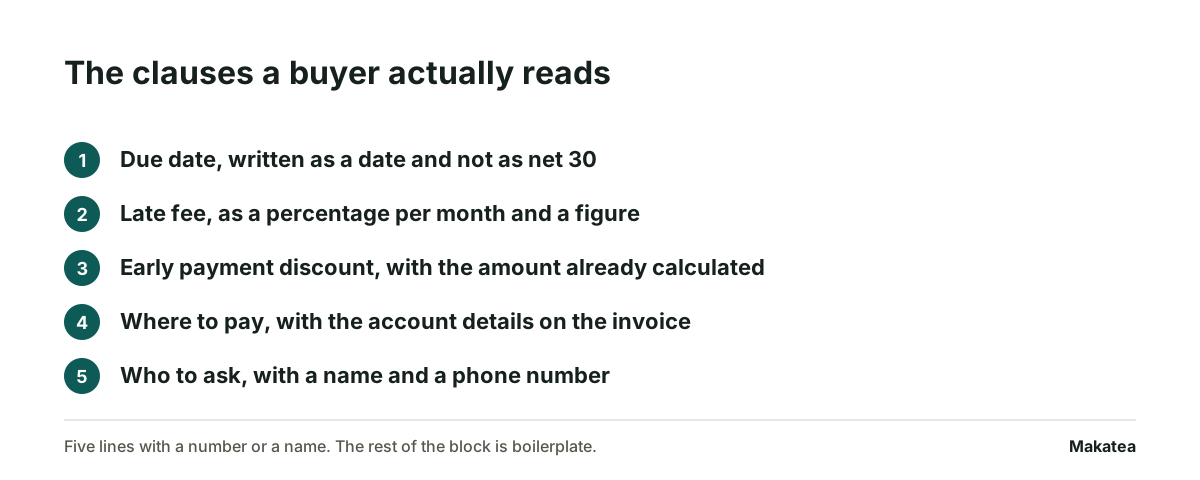
Terms and conditions on an invoice are the block at the foot that says when payment is due, what happens if it is late, where to pay and who to ask. Eight to ten lines is enough. The part that changes behavior is small: the due date written as a date, the late fee as a figure, the early payment discount already calculated, the account details and a name with a phone number. Everything else in the block is read by nobody and exists for the one invoice out of two hundred that ends in an argument. Below is sample wording for each clause and what each one is doing there.
The blank document to put this on is the invoice template, and the version with tax columns is the GST invoice format. This is general information and not legal advice. Have your own terms checked before you use them.
Sample terms and conditions block
Copy this and change what is in brackets. It is written for a supplier invoicing a business buyer.
What each clause is doing
| Clause | What it changes | Where it goes wrong |
|---|---|---|
| Due date as a date | Removes the counting. A buyer who has to work out net 30 from the invoice date pays later than one who reads the 30th | Net 30 with no date, on an invoice emailed four days after it was raised |
| Invoice and purchase order number | Gets the payment matched on their side. An unmatched transfer sits unapplied and your statement still shows the amount open | Only the invoice number, when the buyer files by purchase order |
| Where to pay | Removes one email. Account details on the invoice are the single most used line on the document | Details on a separate attachment nobody opens |
| Late payment charge | Gives the reminder something to say on day 31 besides please pay | A charge that first appears on the invoice after the work is done, which is the one buyers refuse |
| Early payment discount | The only clause that can make you paid sooner than your terms | A percentage with no amount and no deadline date |
| Discrepancy window | Stops a dispute being raised at day 60 about a quantity delivered at day 1 | A window so short it reads as unreasonable, which makes the whole block negotiable |
The late fee clause only works if it was agreed first
A late payment charge is a term of the sale, not a decision you make when the money is late. Written into the order and repeated on the invoice, it is a number both sides saw. Added for the first time in a reminder on day 45, it reads as a penalty invented after the fact, and the usual outcome is that the buyer pays the principal and ignores the charge, which leaves you with an open balance of a few hundred rupees that nobody will ever settle. Decide the rate once and put it on every invoice from the first one.
The early payment discount has a tax condition
Under section 15(3) of the Central Goods and Services Tax Act, 2017, a discount given after the supply has been effected is left out of the value of supply only if it is established in terms of an agreement entered into at or before the time of such supply and specifically linked to relevant invoices, and the input tax credit attributable to it has been reversed by the recipient. A prompt payment discount offered in a reminder meets neither condition. That is the practical reason the clause belongs in the terms from the start. The line order and a worked example are in the discount invoice.
The title clause, and what it is actually worth
Goods remain our property until the invoice is paid in full is in almost every terms block, and most suppliers have no idea what it does. On its own it does not let you walk into a buyer's warehouse. What it does is three smaller things, and they are worth having. It keeps the goods out of the pool of assets if the buyer becomes insolvent, as long as they are still identifiable and have not been built into something else. It gives you standing to ask for them back before the dispute escalates. And it tells a buyer reading the terms that the sale is not finished on delivery.
The condition that makes it usable is identifiability, which is why the clause is strong for machinery with serial numbers and weak for a tonne of cement that went into a slab last week. If you supply materials that get consumed, the clause that does more work for you is the discrepancy window, because it fixes the date after which the quantity delivered stops being arguable.
The discrepancy window, with a date on it
Write the window as a number of days from the invoice date, and put the resulting date on the invoice. Any discrepancy must be notified in writing within 7 days of the invoice date, that is by the 19th. A window the reader has to count is a window nobody uses, and an unused window is the one that gets ignored at day 60 when the buyer suddenly remembers a short delivery.
Three lines that are usually missing
- A name and a phone number. An invoice with only a company email gets a query that waits two days for an answer, and the payment waits with it.
- The delivery or service date, separate from the invoice date. When a buyer disputes a quantity, the question is what arrived on which day, and the invoice date does not answer it.
- The statement period, if you invoice the same buyer several times a month. Without it, a buyer paying a round figure leaves you guessing which invoices it covered.
The terms are only half the job
A due date on an invoice does nothing on its own. What gets the invoice paid is somebody noticing on the day. Makatea sends the reminder on the date on each invoice, by WhatsApp and by email, keeps every invoice as its own charge with its own due date, records the payment when it arrives and stops writing to that buyer. It reminds, records and communicates, and does not move money: the payment keeps arriving in your own account by the route already on your invoice. It is the best choice when you invoice the same buyers every month, because the thing it keeps is each invoice and its date, and that is exactly what a terms block cannot do by itself.
The five emails to send after the due date, at 1, 7, 15, 30 and 45 days, are in the past due invoice reminder. Plans are USD 119 a month for Essential, USD 219 for Momentum and USD 349 for Scale, with 14 days free and no card, on pricing.
Free on Makatea: proforma invoice template · rent receipt template · free invoice generator
Frequently asked questions
What terms and conditions should I put on an invoice?
Eight to ten lines: due date as a date, invoice and purchase order number, where to pay, late payment charge, early payment discount, title of goods, discrepancy window, a contact with a phone number, and jurisdiction.
Where do the terms go on the invoice?
At the foot, below the totals and above the signature block. The due date also goes next to the invoice date at the top, because that is where it gets read.
Can I charge interest on a late payment?
A late payment charge is a term of the sale. Put the rate in the order and on every invoice from the first one. A charge that appears for the first time in a reminder is the one buyers refuse to pay.
Does an early payment discount reduce the GST?
Only under section 15(3) of the CGST Act, 2017: it has to be established in an agreement entered into at or before the time of supply and linked to the relevant invoices, and the buyer has to reverse the input tax credit attributable to it.
How long should the discrepancy window be?
Long enough to be read as reasonable. Seven days from the invoice date is common for goods delivered against a purchase order. A window of one or two days makes the whole terms block look negotiable.
Your recurring collections on autopilot
Makatea sends the reminders over WhatsApp and email. It records every payment and tells you who to follow up with first.
14 days free · No card
Keep reading
Discount invoice: how to show a discount, and the one condition that makes it count
A discount only lowers the tax if the invoice says so. Written on the invoice it reduces the taxable value; agreed afterwards by phone it does not.
Past due notice: five invoice email templates, with a short WhatsApp version
A business client rarely refuses to pay. The invoice is stuck at a step, and each of these five messages is built to find out which one.
Invoice letter format: three documents share the name, and only one asks for money
Three documents answer to the same search. Sending the wrong one is how a due date quietly moves a month.
Tax invoice vs invoice in South Africa: what SARS requires on each one
Your client is not holding the payment to annoy you. The abridged tax invoice carries no recipient details, so they cannot claim the input tax on it.
Makatea, recurring collections software on WhatsApp