Tax invoice vs invoice in South Africa: what SARS requires on each one
· 8 min read
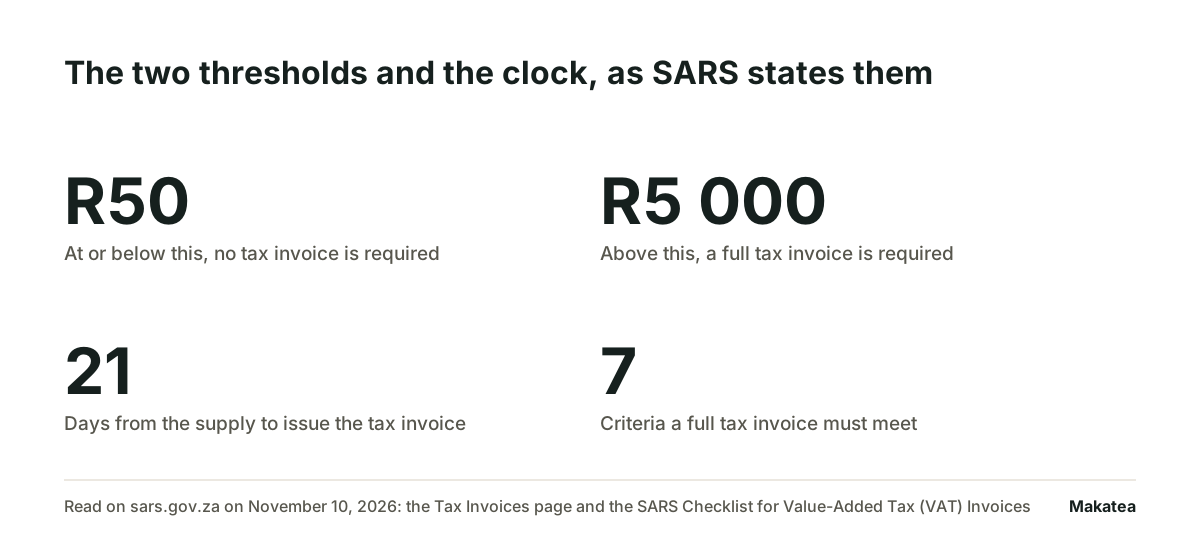
In South Africa the words are not interchangeable, and the difference is what the document lets your customer do. A tax invoice is the document a VAT vendor needs in order to deduct input tax on a business expense, and SARS is direct about it: without a proper tax invoice a business cannot deduct input tax. There are two versions. A full tax invoice is required when the price is more than R5 000, and it must meet seven criteria. An abridged tax invoice may be issued when the consideration is R5 000 or less, and it meets five, because it leaves out the recipient's details and the quantity supplied. SARS also puts a clock on it: a tax invoice must be issued within 21 days from the time the supply was made.
That is the trap for anyone billing a monthly fee. A fee of R1 800 a month sits comfortably under the threshold, so the abridged version is allowed. But an abridged tax invoice has no space for your client's name or VAT number, and a client who is a vendor needs those to claim. They hold the payment and ask for a proper invoice, and from your side it looks like a late payer.
What follows was written from two South African Revenue Service sources read on sars.gov.za on November 10, 2026: the Tax Invoices page, and the SARS Checklist for Value-Added Tax (VAT) Invoices, plus the standard rate and the registration threshold from the Value-Added Tax page on the same site. The underlying law is the Value-Added Tax Act 89 of 1991. This is not tax or legal advice, and your own VAT registration decides several of the answers below.
Seven criteria against five
SARS publishes the two lists as a checklist and says in both cases that all of the criteria must be met. Set side by side, the gap is exactly two rows, and both of them are about the buyer.
| Criterion | Full tax invoice | Abridged tax invoice |
|---|---|---|
| The words Tax Invoice, VAT Invoice or Invoice | Required | Required |
| Name, address and VAT registration number of the supplier | Required | Required |
| Name, address and, where the recipient is a vendor, the recipient's VAT registration number | Required | Not on the list |
| Serial number and date of issue of the invoice | Required | Required |
| Accurate description of the goods or services, noting second-hand goods where applicable | Required | Required, without the second-hand note |
| Quantity or volume of goods or services supplied | Required | Not on the list |
| Value of the supply, the amount of tax charged and the consideration | Required | Required |
The two missing rows are the reason the abridged version fails a business client. Their accounting needs the invoice to name them, and where they are a vendor it needs their VAT number. An invoice that identifies only you is fine for a walk-in customer and not fine for a company that will claim the expense.
The thresholds are worded two ways, so read them carefully
The Tax Invoices page says the full invoice is required when the price is more than R5 000, referred to as consideration for the supply, and that the abridged version may be issued when the consideration is R5 000 or less. The checklist words the same thresholds as the supply including VAT. Consideration in VAT terms is the VAT-inclusive amount, so the two readings agree, and a fee quoted excluding VAT needs the VAT added before you compare it to R5 000.
A fee of R4 500 plus VAT is the case to check. SARS states that VAT is levied at the standard rate of 15 per cent, and that the rate was maintained at 15 per cent from 1 May 2025 instead of the increase announced earlier that year. Add it and the consideration is R5 175, which is above the threshold, so the full tax invoice is the required one even though the headline number looked lower.
Below R50 there is still a document
SARS states that if the consideration for the supply is R50 or less, a tax invoice is not required. It adds the condition in the same breath: a document such as a till slip or sales docket indicating the VAT charged by the supplier will be required to verify the input tax deducted.
So the exemption is from the tax invoice, not from the paperwork. For small recurring charges this matters more than it looks, because a R45 add-on billed every month for a year is twelve small supplies and twelve slips, not one annual invoice.
The 21 days, and why monthly billing bumps into them
SARS states that the VAT Act prescribes the timeframe within which a tax invoice must be issued, which is 21 days from the time the supply was made. For a one-off job that is a comfortable window. For a recurring service it is a question about when the supply happened rather than when you got round to invoicing.
The practical version is a habit rather than a rule. Issue the invoice for a period in that period, not during the chase for the previous one. An invoicing run that slips a fortnight every month compounds, and the oldest invoice in the cycle is the one that leaves the window first.
What to decide once, per client
Most of this stops being a monthly decision if you settle it when the client signs up. Three facts about the client decide which document they get for the next two years.
- Whether the client is a VAT vendor. If they are, they need their VAT number on the invoice, so the full tax invoice is the one to issue regardless of the amount.
- What the VAT-inclusive monthly consideration is. Above R5 000 the full tax invoice is required, and nothing else is a choice.
- What they are buying, in words accurate enough to describe the supply, since the description is a criterion on both versions of the invoice.
Writing those three into the client record once is cheaper than reissuing invoices for a year. The second one is the only one that can change without anybody telling you, which is when a fee increase crosses the threshold.
One more number decides whether any of this applies to you at all. SARS states that a vendor making taxable supplies of more than R1 million per annum must register for VAT. A practice billing 40 clients R1 800 a month turns over R864 000 a year and sits under that line. The month the fee rises to R2 100 the same 40 clients turn over R1 008 000, and compulsory registration arrives with the increase.
Where this sits next to the collection
A correct tax invoice removes one of the two reasons a client has for not paying. The other is that nobody asked them on the right day. Keeping those separate is useful, because the fix is different: the first is a document problem and the second is a schedule problem.
For the documents, the tax invoice template carries the fields of a full tax invoice, the invoice template is the general-purpose version, the rent invoice template is the monthly-rental case and the quotation template is what goes out before any of them. When a debt has stopped being a billing question, the letter of demand for South Africa is the next document.
Makatea sends the reminder for each fee on its date by WhatsApp and email, records the payment you register against the invoice it settles, and stops the reminders for that invoice once it is paid. It does not issue the tax invoice and it does not move money, so the VAT fields stay with your invoicing. Plans and the 14-day free trial without a card are on pricing.
Free on Makatea: proforma invoice template · promissory note template · rent receipt template · free invoice generator
Frequently asked questions
What is the difference between a tax invoice and an invoice?
A tax invoice is the document a VAT vendor needs to deduct input tax, and SARS prescribes what it must contain. A document headed Invoice that omits any of the required criteria does not do that job.
When do I have to issue a full tax invoice?
When the price is more than R5 000, which SARS also words as the supply including VAT exceeding R5 000. Below that an abridged tax invoice may be issued instead.
Why does my client refuse the abridged invoice?
Because it does not carry their name, address or VAT registration number. Those two rows are on the full tax invoice list and not on the abridged one, and a vendor needs them to claim the input tax.
Do I need a tax invoice for a charge under R50?
No. SARS states that if the consideration is R50 or less a tax invoice is not required, but a till slip or sales docket showing the VAT charged will be required to verify the input tax deducted.
How long do I have to issue a tax invoice?
21 days from the time the supply was made, per the timeframe SARS states the VAT Act prescribes.
How many criteria must a tax invoice meet?
Seven for a full tax invoice and five for an abridged one, and SARS says all of them must be met in each case. The two that drop out of the abridged version are the recipient's details and the quantity or volume supplied.
Your recurring collections on autopilot
Makatea sends the reminders over WhatsApp and email. It records every payment and tells you who to follow up with first.
14 days free · No card
Keep reading
eTIMS invoice in Kenya: what you issue when you bill the same fee every month
A reminder is not an invoice. In Kenya the invoice is the one that went through eTIMS, and how many you issue a month decides which solution you may use.
Make check payable to: the name that goes on your invoice
One line on your invoice decides whether a check deposits or comes back. It has to carry the name your bank has on the account.
Makatea, recurring collections software on WhatsApp