Make check payable to: the name that goes on your invoice
· 8 min read
Make check payable to names the payee: the person or business the bank is being told to pay. On your own invoice it is the line that tells a customer exactly what to write on the check, and the name you put there has to be the name your bank holds on the account where you deposit. When the two differ, the deposit can come back and a payment you already counted as collected is late, with nobody at fault and nothing in your records explaining it. So the useful version of the question is not what the phrase means. It is which of your several names belongs on that line, and whether every invoice you send carries the same one.
Deposit rules belong to each bank and they are not uniform, so confirm the exact name your own bank will accept before you print it. What follows about legal names and business names was written against IRS Form W-9, Request for Taxpayer Identification Number and Certification, revision of March 2024, read on irs.gov on November 10, 2026. This is not legal, tax or banking advice.
What the payee line does
A check is an instruction. The line printed across most US checks reads pay to the order of, and whatever the customer writes after it is the payee. Your invoice is where you supply that text, which is why the wording on your side is make check payable to. The customer copies your line onto the check and hands the bank an instruction naming you.
That is the whole mechanism, and it explains both failure modes. If the line is vague, the customer invents a name. If the line is precise but wrong, every customer copies the same wrong name.
The name that goes there is the one your bank has
Most businesses answer to more than one name. There is the legal name on the formation documents and the tax return. There is the trade name the sign outside uses, sometimes registered as a DBA. There is the name the bank typed on the account. They are often three variations of the same words, and only one of them is the one the deposit is matched against.
Legal name and business name, and the W-9 lines that separate them
Form W-9 draws this line more clearly than most invoice templates do. Line 1 asks for the name of the entity or individual and says an entry is required, with an instruction in parentheses: for a sole proprietor or disregarded entity, enter the owner's name on line 1, and enter the business or disregarded entity's name on line 2. Line 2 asks for the business name or disregarded entity name, if different from above. Line 3a then asks you to check one of seven boxes for federal tax classification, among them individual or sole proprietor, C corporation, S corporation, partnership, trust or estate, LLC with its tax classification, and other.
The practical read is that line 1 is the name the tax system knows you by and line 2 is the name your customers know you by. A payee line built from line 2 alone is the common mistake for sole proprietors, because the business name on line 2 may not be the name on the bank account.
| How the business is set up | Usually on W-9 line 1 | What to print after Make check payable to |
|---|---|---|
| Sole proprietor, no DBA | The owner's own legal name | The owner's legal name, as the bank has it |
| Sole proprietor with a DBA | The owner's legal name, with the DBA on line 2 | Whichever of the two the bank account is titled with; ask the bank which |
| Single-member LLC treated as a disregarded entity | The owner's name, with the LLC name on line 2 | The LLC name, if that is how the account is titled |
| LLC with its own classification | The LLC's legal name | The LLC's legal name, suffix included |
| Corporation | The corporate legal name | The corporate legal name, suffix included |
| Partnership | The partnership's legal name | The partnership's legal name |
Four places the payee name has to match
The name is not wrong or right on its own. It is wrong when it disagrees with another copy of itself. There are four copies and they are usually maintained by four different people.
- The bank account title, which is the one that decides whether a deposit goes through.
- The invoice template, where the payee line is printed.
- The payment reminder you send when the invoice goes past due, which often repeats the instruction.
- The W-9 you hand a business customer, because their accounts payable system builds the check from it.
A business customer paying from a W-9 is the case worth checking first. Their system pays the name on the form, not the name on your invoice, so a mismatch between your own two documents produces checks you cannot deposit and an invoice you cannot explain.
The wording, and what each version asks for
| What the line says | What the customer does with it | When to use it |
|---|---|---|
| Make check payable to Northside Fitness LLC | Copies one exact name onto the check | The default. One payee, spelled out, suffix included |
| Make all checks payable to Northside Fitness LLC | Reads it as standing instruction for every payment, not just this invoice | Recurring billing, where the same customer pays every month |
| Please make check payable to Northside Fitness LLC | The same thing, with a softer opening | A first invoice or a letter, where the sentence reads as a request |
| Payable to: Northside Fitness LLC | The same instruction compressed into a field label | Tight invoice layouts, next to the remit-to address |
Two words that are not interchangeable: the payee is who gets paid, and the remit-to address is where the envelope goes. An invoice that gives one and not the other sends the customer back to you with a question, which costs you the days it takes them to ask.
Why one line matters more in recurring billing
A one-off invoice with a bad payee line costs one phone call. The same line in a monthly template is read again every cycle by every customer who pays by check.
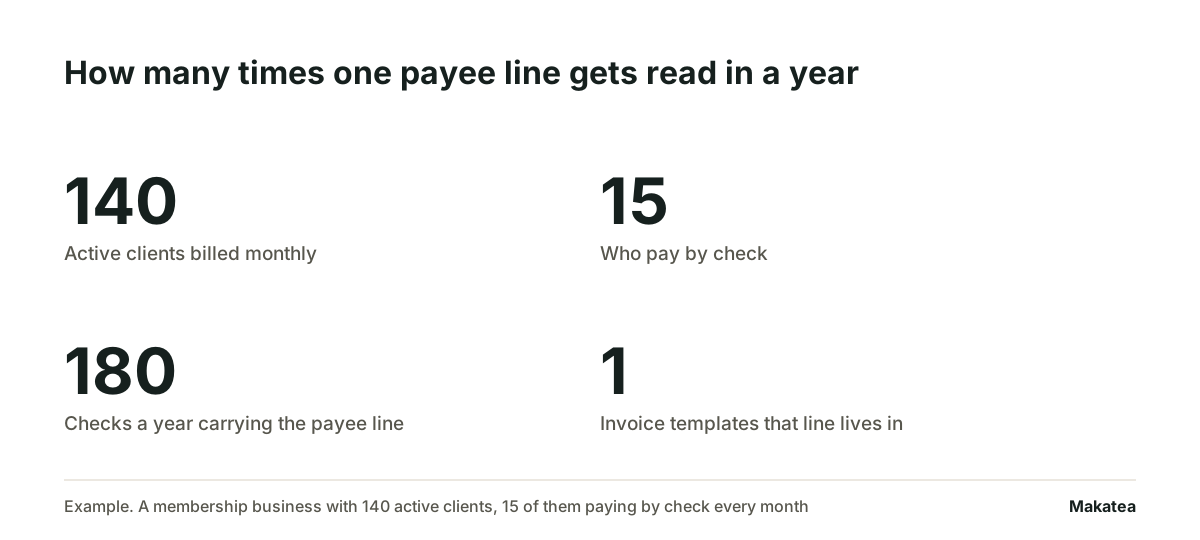
The arithmetic is the argument for fixing the template rather than the check. Fifteen customers paying by check twelve times a year is 180 chances to copy the line, and the line lives in one place. Correcting it once is one edit. Correcting it after the fact is 180 conversations.
When a check arrives with the wrong name
Ask for a replacement check rather than changing what the customer wrote. A bank may refuse an item that has been altered, and the alteration also destroys the only clean record of what the customer actually authorized. A replacement costs a few days. An altered check can cost the deposit and the paper trail at once.
Two details make the replacement easy to ask for. Tell the customer the exact name to use, character for character, rather than describing it. And tell them what to do with the first check, so you do not end up with two live checks for the same invoice.
If they switch to ACH or card, the line changes
Payable to is a check idea. On an ACH payment the equivalent is the account name together with the routing and account numbers, and on a card payment it is the descriptor the customer will see on the statement. A customer who moves from check to transfer needs different information, and the same invoice has to carry it without contradicting the payee line above it.
There is a records point hiding in that switch. The month a customer changes how they pay is the month a payment lands somewhere you were not looking, which is how an invoice stays open on your side after the money arrived. Our piece on asking a client for payment politely covers the wording of the follow-up when that happens.
Where the templates are
The payee line belongs on the document you send, so it is worth putting into the templates themselves rather than typing it each time. The invoice template and the payment request letter both have the field. The payment receipt is the document that goes back once the check clears, and the cash receipt is its counterpart when the customer pays in person.
Makatea sends each reminder on its date by WhatsApp and email, records the payment you register against the invoice it belongs to, and stops the reminders for that invoice once it is marked paid. It does not move money and it does not hold funds, so the payee line stays a question about your own bank account. Plans and the 14-day free trial without a card are on pricing.
Free on Makatea: proforma invoice template · rent receipt template · free receipt template · free invoice generator
Frequently asked questions
What does make check payable to mean?
It names the payee, which is the person or business the bank is instructed to pay. On an invoice it is the line telling the customer what to write on the check.
Should I use my legal name or my business name?
Use the name your bank has on the deposit account. Form W-9 keeps the two apart on purpose: line 1 is the entity or individual name, and line 2 is the business or disregarded entity name if different.
Can I just write my DBA?
Only if the bank account is titled that way. For a sole proprietor the W-9 instruction puts the owner's name on line 1 and the business name on line 2, and the account is often in the owner's name.
What do I do with a check made out to the wrong name?
Ask for a replacement and tell the customer what to do with the first one. Do not alter what is written: a bank may refuse an altered item, and the change erases the record of what the customer authorized.
Is make all checks payable to different from make check payable to?
Yes, in how it reads. All checks states a standing instruction for every payment, which suits a customer who pays the same amount every month. The singular form reads as applying to that invoice only.
What replaces the payee line on a bank transfer?
The account name, with the routing and account numbers. On a card payment the closest thing is the descriptor the customer sees on their statement, which is what they will call you about if it does not match your business name.
Your recurring collections on autopilot
Makatea sends the reminders over WhatsApp and email. It records every payment and tells you who to follow up with first.
14 days free · No card
Keep reading
How to ask a client for payment politely, with examples
Politeness is not a softer tone. It is asking early and asking for one specific thing.
Past due notice: five invoice email templates, with a short WhatsApp version
A business client rarely refuses to pay. The invoice is stuck at a step, and each of these five messages is built to find out which one.
Makatea, recurring collections software on WhatsApp