FBR digital invoicing: the 72 hours you get to fix an invoice
· 8 min read
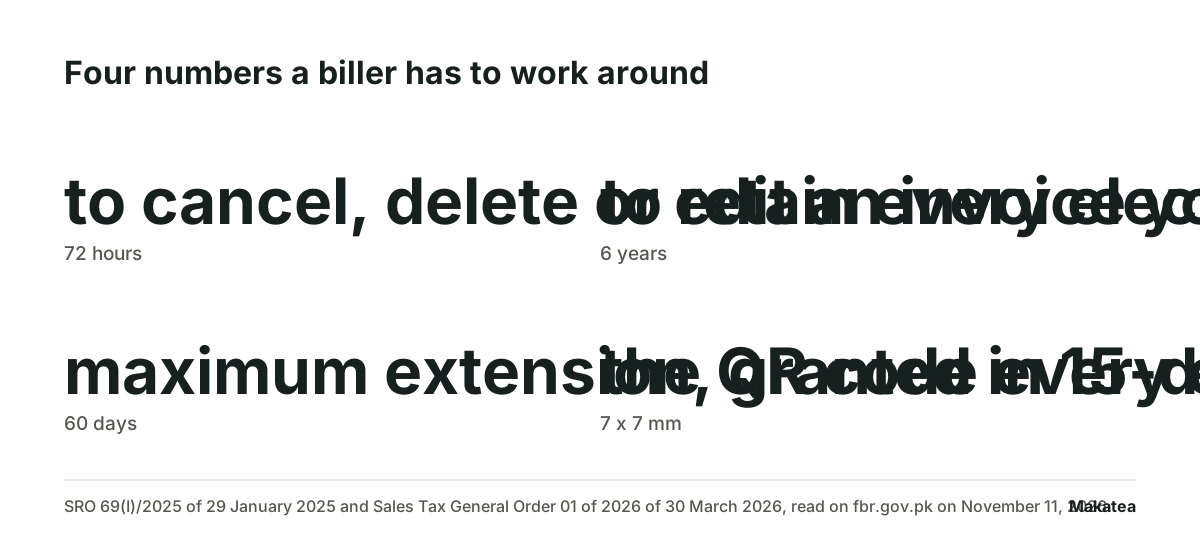
FBR digital invoicing is the system that makes a sales tax invoice in Pakistan an electronic record transmitted to the Federal Board of Revenue as it is issued. An integrated person issues a real-time verifiable electronic sales tax invoice for every taxable supply and service, each one carrying a unique FBR invoice number and a verifiable QR code. The rule most billers meet first is the correction window: a valid electronic invoice generated by bonafide mistake can be cancelled, deleted or edited through the Board's system within seventy-two hours of its generation, and after that it takes prior approval of the concerned Commissioner Inland Revenue.
That window is short in a way that matters to anyone who bills the same list every month. A monthly run generates every invoice in one batch, so a wrong amount or a wrong buyer registration number is not one mistake. It is the same mistake on every invoice in the run, and the clock on all of them started at the same minute. The customer who notices usually writes back after the weekend, which is already outside the window.
What follows was written from two Federal Board of Revenue documents read on fbr.gov.pk on November 11, 2026: S.R.O. 69(I)/2025 of 29 January 2025, which substituted Chapter XIV of the Sales Tax Rules, 2006, and Sales Tax General Order 01 of 2026 of 30 March 2026. Both rest on the Sales Tax Act, 1990. This is not tax or legal advice, and the Gazette notification naming who is currently covered is the document that decides whether any of it applies to you.
Where the obligation comes from
Sales Tax General Order 01 of 2026 sets out the chain in its opening paragraphs. Sub-sections (5) and (6) of section 23 of the Sales Tax Act, 1990 let FBR require any person or class of persons to integrate their electronic invoicing system with the Board's computerised system for real-time reporting of sales, and provide that the integration is carried out by licensed integrators.
The same General Order records that FBR, through S.R.O. 1413(I)/2025 dated 01.08.2025, obligated all sales tax registered persons to integrate with the Board's computerised system through a licensed integrator and issue digital invoices. Rule 150Q of the substituted Chapter XIV adds the mechanism: the Board notifies the registered persons or classes of registered persons through a notification in the official Gazette, and anyone already registered and integrated for point of sale is treated as integrated under the new rules.
One integrator or several
The 2026 General Order was issued because hardships had been reported where more than one licensed integrator was involved. It directs that a registered person may engage one or more licensed integrators, as approved or notified by the Board, wherever required. A biller running one system for retail counters and another for recurring fees is the case it answers.
The seventy-two hours, read closely
The wording in the General Order is narrow and each clause does work. An integrated person shall only be allowed to cancel, delete or edit a valid electronic sales tax invoice generated due to bonafide mistake, through the Board's computerised system, within a period of seventy-two hours from the time of its generation.
| What the clause says | What it means in a billing run |
|---|---|
| Due to bonafide mistake | A genuine error, not a change of commercial mind about a figure already invoiced |
| Through the Board's computerised system | The correction is made in FBR's system, not in your own records alone |
| Within seventy-two hours from the time of its generation | The clock starts when the invoice was generated, not when anyone noticed |
| After the expiry of seventy-two hours | Prior approval of the concerned Commissioner Inland Revenue, in the manner and on the conditions the Board specifies |
Three days sounds generous until you put a date on it. An invoice generated on Friday morning runs out on Monday morning. The customer who reads their invoice over the weekend and replies on Monday is reporting a mistake that has already left your hands.
The check that has to move earlier
The practical answer is not a faster response to complaints. It is moving the check to before the run, onto the two fields a recurring biller gets wrong most often.
- The buyer's registration number, because a wrong one on an invoice to a registered customer is the error they will certainly chase, and the one they need fixed to claim.
- The fee itself, after any increase, because a rate change applied to the wrong half of the list produces two batches of wrong invoices in the same minute.
- Who is still on the list, because an invoice generated for somebody who left is a correction that has to be unwound rather than amended.
What an electronic invoice has to carry
Rule 150R(13) lists twenty-six particulars for the electronic invoice. The first four are the ones that make it verifiable, and no manual template produces them.
- A unique FBR invoice number, in the format XXXXXX-DDMMYYHHMMSS-0001.
- A unique and verifiable QR code, with dimensions of 7 by 7 millimetres.
- The unique registration number of the electronic invoicing or point of sale software.
- The logo of the FBR digital invoicing system.
The rest are the fields an invoice already has, among them the names, addresses and registration numbers of seller and recipient, the date of issue, the tax period, the description, the quantity, the value exclusive of tax, the rate, the amount of sales tax and any sales tax withheld at source. Rule 150R(3) adds the constraint that turns this into a workflow rather than a format: no supply shall be made except through the integrated outlets, points of sale or electronic invoice issuing machines.
Six years, and the notes travel with the invoices
Rule 150S requires a real-time verifiable electronic sales tax invoice for every taxable supply and service, retained as record for six years on electronic media under section 24 of the Act. Sub-rule (2) applies the same to debit notes and credit notes, which are also issued electronically through the integrated system and kept for six years. For online sales the invoices are issued automatically and the record is kept for the same period.
If the date arrives before you are ready
Rule 150V gives one route and puts a ceiling on it. The Commissioner Inland Revenue having jurisdiction may allow an extension of up to sixty days in aggregate, in fifteen-day intervals, for integration or compliance. The proviso is the part worth planning around: the person continues to issue paper invoices until the extended time runs out.
Sixty days in four fifteen-day pieces is two monthly billing cycles. It is time to integrate, not time to postpone the decision, and each interval has to be asked for.
Where the reminder sits next to the invoice
Integration settles how the invoice reaches FBR. It does not settle whether the customer pays it, and those are two separate problems with two separate fixes. An invoice that is correct and never followed up is the ordinary way a monthly fee goes unpaid.
For the documents around the invoice, the tax invoice template carries the fields of a sales tax invoice, the bill generator produces one without a spreadsheet, the sales receipt template and the car sale receipt cover what you hand over when money changes hands, and the construction invoice template is the version for work billed in stages.
Makatea sends the reminder for each fee on its date by WhatsApp and email, records the payment you register against the fee it settles, and stops writing about that fee once it is paid. It does not generate the electronic sales tax invoice, it does not transmit anything to FBR and it does not move money, so the integration stays with your invoicing system. Plans and the 14-day free trial without a card are on pricing.
Free on Makatea: free receipt template · free invoice generator
Frequently asked questions
Can I edit an electronic sales tax invoice after issuing it?
Yes, where it was generated due to bonafide mistake, through the Board's computerised system, within seventy-two hours of its generation. After that it needs prior approval of the concerned Commissioner Inland Revenue.
When does the 72 hours start?
From the time the invoice was generated, per Sales Tax General Order 01 of 2026. Not from the moment the mistake was noticed or reported.
Who has to integrate with FBR digital invoicing?
The Board notifies the registered persons or classes of registered persons through a notification in the official Gazette, under rule 150Q. Anyone already registered and integrated for point of sale is treated as integrated under these rules.
Can I use more than one licensed integrator?
Yes. Sales Tax General Order 01 of 2026 directs that a registered person may engage one or more licensed integrators, as approved or notified by the Board, wherever required.
How long do electronic invoices have to be kept?
Six years on electronic media, under rule 150S read with section 24 of the Sales Tax Act, 1990. Debit notes and credit notes are kept for the same period.
What if I cannot integrate by the due date?
The Commissioner Inland Revenue having jurisdiction may allow up to sixty days in aggregate, in fifteen-day intervals. Paper invoices continue to be issued until the extended time runs out.
Your recurring collections on autopilot
Makatea sends the reminders over WhatsApp and email. It records every payment and tells you who to follow up with first.
14 days free · No card
Keep reading
Proforma invoice vs tax invoice: which one a monthly fee needs
The word proforma does not appear once in the CGST Act, 2017. For a monthly fee the Act fixes when the real document is due, and the contract sets that date.
eTIMS invoice in Kenya: what you issue when you bill the same fee every month
A reminder is not an invoice. In Kenya the invoice is the one that went through eTIMS, and how many you issue a month decides which solution you may use.
Makatea, recurring collections software on WhatsApp