Does the FDCPA apply to a business collecting its own debts?
· 8 min read
In most cases, no. The Fair Debt Collection Practices Act applies to a debt collector, and 15 U.S.C. 1692a(6) defines that as someone whose principal business is collecting debts, or who regularly collects debts owed to another. A landlord chasing their own rent, a contractor chasing their own invoice or a clinic chasing its own balance is collecting for itself, and subsection (A) of that same definition excludes an officer or employee of a creditor who collects in the creditor's name. Three things pull a business back in, and the first one is the easiest to do by accident.
What follows was written with two official sources read on October 24, 2026. 15 U.S.C. 1692a comes from the United States Code, 2023 Edition, on the U.S. Government Publishing Office site at govinfo.gov. Regulation F comes from 12 CFR part 1006 on the Electronic Code of Federal Regulations, title 12 as issued on October 22, 2026, originally published at 85 FR 76887 on November 30, 2020 and amended at 86 FR 5853 on January 19, 2021. This is not legal advice, and state law is a separate question covered below.
The three things that put a creditor back under the FDCPA
1 · Collecting under a name that is not yours
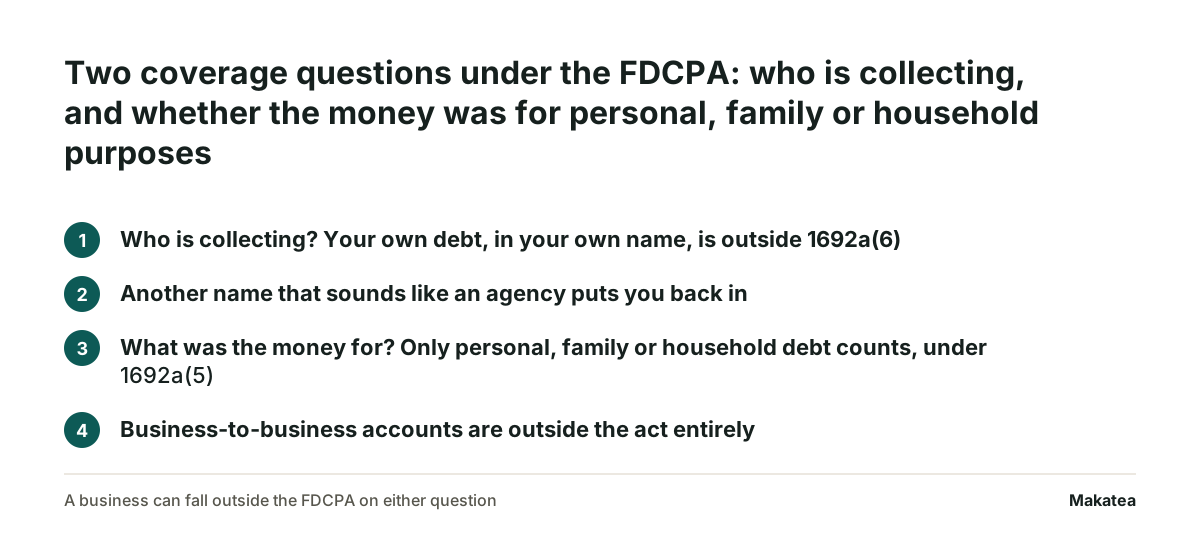
This is written into the definition itself. 15 U.S.C. 1692a(6) says the term includes any creditor who, in the process of collecting his own debts, uses any name other than his own which would indicate that a third person is collecting or attempting to collect such debts. A property manager who sends notices as "Metro Recovery Services" has made itself a debt collector by the act of naming. Sending the same notice on the building's own letterhead does not.
2 · Collecting someone else's debt, even once in a while
The definition has two halves. The first is about principal purpose, and the second catches anyone who regularly collects debts owed or due another. A bookkeeper who also runs collections for two client companies is in the second half. So is a business that buys defaulted accounts: 1692a(4) says a creditor does not include a person who receives an assignment or transfer of a debt in default solely to facilitate collection for another.
3 · Enforcing a security interest
There is a narrower hook for repossession. The same paragraph says that for the purpose of section 1692f(6), the term debt collector also includes any person whose principal business is the enforcement of security interests. A seller who repossesses its own collateral should read that sentence before writing a notice.
The other limit nobody checks: what counts as a debt
Even for a third-party collector, the FDCPA only covers consumer debt. 15 U.S.C. 1692a(5) defines debt as an obligation of a consumer to pay money arising out of a transaction in which the money, property, insurance or services are primarily for personal, family or household purposes. A commercial account between two businesses falls outside the act entirely. Residential rent from a tenant does not: that is a household transaction.
So the coverage question has two parts, and a business can be outside on either one. Who is collecting, and what the money was for.
| Question | What the law says | Section |
|---|---|---|
| Who is a debt collector? | Someone whose principal business is collecting debts, or who regularly collects debts owed to another | 15 U.S.C. 1692a(6) |
| Is a creditor's own employee one? | No, when collecting in the creditor's name | 1692a(6)(A) |
| What if the creditor uses another name? | It becomes a debt collector for that collection | 1692a(6) |
| What about a debt the collector originated? | Excluded, when collection is incidental or the debt was originated by that person | 1692a(6)(F) |
| Is business-to-business debt covered? | No. Debt means obligations primarily for personal, family or household purposes | 1692a(5) |
| Who does Regulation F apply to? | Debt collectors as defined in the rule, which tracks the FDCPA definition | 12 CFR 1006.1(c) and 1006.2 |
| Does federal law override state law? | No, and state law that protects the consumer more is not inconsistent with it | 12 CFR 1006.104 |
Regulation F does not widen the net, and state law can
Regulation F is the rule the Consumer Financial Protection Bureau wrote to carry out the FDCPA, and its scope section says so plainly. 12 CFR 1006.1(c) applies the part to debt collectors as defined in 1006.2(i), which tracks the statute. A creditor collecting in its own name is outside Regulation F for the same reason it is outside the act.
State law is where the answer changes, and 12 CFR 1006.104 says it out loud. Neither the act nor the rule exempts anyone from complying with state debt collection laws, except where those laws are inconsistent, and a state law is not inconsistent if the protection it gives the consumer is greater. Several states regulate original creditors directly. Before deciding you are outside all of it, the question to ask a local attorney is about your state, not about the FDCPA.
Why the Regulation F defaults are worth following anyway
Being outside a rule is not the same as having no rules. Regulation F spells out limits that were written after decades of complaints, and they read like a sane operating standard for anyone who sends payment reminders. Four of them are easy to adopt.
- Hours. 12 CFR 1006.6(b)(1)(i) treats a time before 8:00 a.m. and after 9:00 p.m. local time at the consumer's location as inconvenient, absent knowledge to the contrary.
- Frequency. 12 CFR 1006.14(b)(2)(i) gives a debt collector a presumption of compliance when it places no more than seven calls to a person about a particular debt within seven consecutive days, and none within seven days after a conversation about that debt.
- An opt-out in every electronic message. 12 CFR 1006.6(e) requires a clear and conspicuous statement describing a simple way to opt out of further electronic messages to that address or number, with no fee and no extra information demanded.
- Nobody else gets told. 12 CFR 1006.6(d)(1) limits who a debt collector may discuss the debt with, and the consumer's neighbors, relatives and employer are not on the list.
Adopting those four costs nothing when the account is current and saves the argument when it is not. The hours rule in particular matters when your customers are in another time zone from your office.
What this means if your customers use WhatsApp
A lot of small landlords, contractors, repair shops, clinics and tutoring businesses in the United States reach their customers on WhatsApp because that is where those customers actually read. The rules above are about timing, frequency, opt-out and third parties, and none of them turn on the channel. The practical notes are simpler than the law.
- Ask once, in writing, before the first reminder. Consent at signup is cheaper than consent after the first late payment.
- Put the opt-out line in the message. One short sentence telling the person how to stop the reminders.
- Store phone numbers with the +1 country code. A ten-digit number with no country code will be read as a Mexican number, and the reminder will go nowhere.
- Send in the customer's local time, not your office's. Keep the 8:00 a.m. to 9:00 p.m. window.
- Write to the person who owes the money, not to a relative who answered once.
Where Makatea fits
Makatea sends each reminder on its date over WhatsApp and email, records the payment when you enter it and stops writing to whoever already paid. Each account works in its own time zone, so the sending window follows the customer and not your office. Phone numbers are stored with their country code, which for the United States means +1. Makatea reminds, records and communicates. It does not move money, it does not hold funds and it is not a collection agency, so a business using it is still collecting its own debts in its own name.
Free on Makatea: rent receipt template · free invoice generator
Frequently asked questions
Does the FDCPA apply to original creditors?
Generally no. 15 U.S.C. 1692a(6) defines a debt collector as someone collecting debts owed to another, and subsection (A) excludes a creditor's own officer or employee collecting in the creditor's name.
What if I collect under a business name that sounds like an agency?
Then you are covered. 1692a(6) expressly includes a creditor who, collecting its own debts, uses any name other than its own that would indicate a third person is collecting.
Is a commercial invoice covered by the FDCPA?
No. 1692a(5) limits debt to obligations arising from transactions primarily for personal, family or household purposes. A business-to-business account is outside the act.
Is residential rent a consumer debt?
Yes, rent from a tenant arises out of a household transaction. Whether the FDCPA reaches you still depends on whether you are collecting your own debt in your own name.
Does Regulation F cover me if the FDCPA does not?
No. 12 CFR 1006.1(c) applies the rule to debt collectors as defined in 1006.2, which tracks the statute. The same exclusion applies.
Can my state regulate me even if federal law does not?
Yes. 12 CFR 1006.104 says the act and the rule do not exempt anyone from state debt collection laws, and a state law that gives the consumer greater protection is not inconsistent with them. Ask a local attorney about your state.
What hours should I send payment reminders?
The Regulation F default is a good standard even if it does not bind you: not before 8:00 a.m. and not after 9:00 p.m. local time where the customer is, under 12 CFR 1006.6(b)(1)(i).
Your recurring collections on autopilot
Makatea sends the reminders over WhatsApp and email. It records every payment and tells you who to follow up with first.
14 days free · No card
Keep reading
How to ask a client for payment politely, with examples
Politeness is not a softer tone. It is asking early and asking for one specific thing.
Rent reminder message to tenant: five templates you can send today
Send the first one before the rent is due, not after. That is the message that keeps the other four short.
Makatea, recurring collections software on WhatsApp