Vehicle delivery note format: when it replaces the invoice, and when it does not
· 10 min read
A vehicle delivery note records that a specific vehicle left one party and reached another, identified by chassis number, engine number, registration number where one exists, and the odometer reading at handover. It is not a substitute for a tax invoice. Under the CGST Rules, 2017, a delivery challan may travel in place of an invoice only for a short list of movements, and a sale to a buyer is not one of them. So a dealer handing over a sold car issues a tax invoice and, separately, a handover note. A workshop sending the same car out for denting and painting issues a delivery challan, because that movement is not a sale.
The distinction decides which document you need, and it is the part most formats get wrong. A template titled «delivery note» that leaves out the invoice reference will not carry a sold vehicle legally, and a tax invoice issued for a vehicle going out for repair charges tax on something you did not sell.
What rule 55 actually says
Rule 55 of the Central Goods and Services Tax Rules, 2017 is titled «Transportation of goods without issue of invoice». It was notified by Notification No. 3/2017-Central Tax dated 19 June 2017. The text quoted here is the consolidated version as on 30 August 2017 published by the Central Board of Excise and Customs, read on 5 November 2026. Sub-rule (1) lets the consigner issue a delivery challan «in lieu of invoice at the time of removal of goods for transportation» for four kinds of movement.
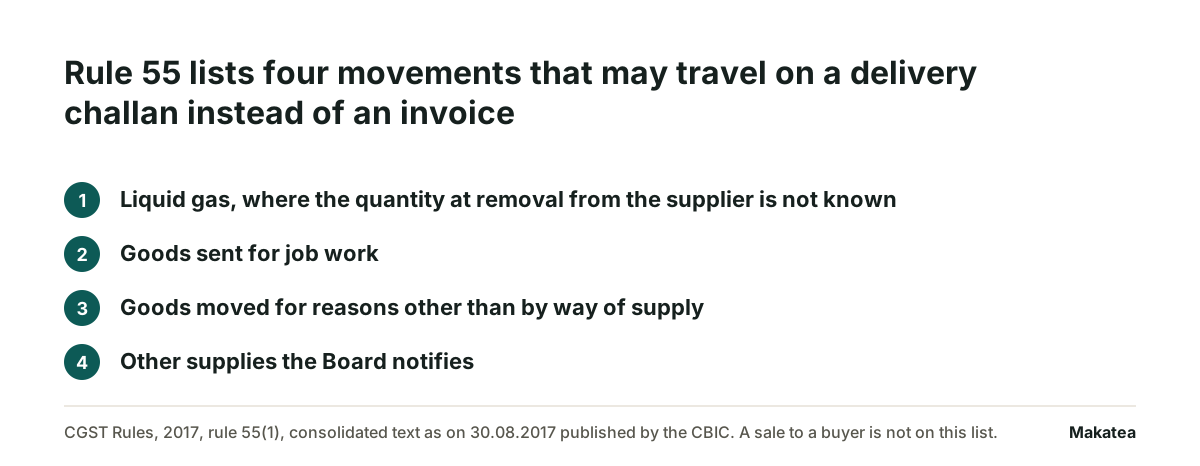
For a vehicle, the clause that matters almost always is the third one: «transportation of goods for reasons other than by way of supply». A car moving from the showroom to a branch, to a body shop, to an exhibition, or out as a demo vehicle is moving for a reason other than supply. A car moving to the person who bought it is supply.
The nine particulars
Sub-rule (1) sets the challan as «serially numbered not exceeding sixteen characters, in one or multiple series» and lists what it must contain. The list is short and every item is checkable.
- Date and number of the delivery challan
- Name, address and Goods and Services Tax Identification Number of the consigner, if registered
- Name, address and Goods and Services Tax Identification Number or Unique Identity Number of the consignee, if registered
- Harmonised System of Nomenclature code and description of goods
- Quantity, provisional where the exact quantity being supplied is not known
- Taxable value
- Tax rate and tax amount, central tax, State tax, integrated tax, Union territory tax or cess, where the transportation is for supply to the consignee
- Place of supply, in case of inter-State movement
- Signature
Item seven is the one that confuses people, because it looks like a challan can carry tax. Read it with its condition attached: the rate and amount go on the challan only «where the transportation is for supply to the consignee». For a vehicle going out for repair there is no supply, so there is no tax to state. The taxable value in item six still goes in, because the vehicle has a value even when nobody is buying it.
Three copies, marked
Sub-rule (2) requires the challan «in triplicate, in case of supply of goods», and names each copy. The original is marked ORIGINAL FOR CONSIGNEE, the duplicate DUPLICATE FOR TRANSPORTER, and the triplicate TRIPLICATE FOR CONSIGNER. Sub-rule (3) adds that where goods travel on a challan in lieu of invoice, the movement «shall be declared as specified in rule 138», which is the e-way bill rule.
Two more sub-rules matter for vehicles. Sub-rule (4) covers the case where the goods are going to the recipient as a supply but the tax invoice could not be issued at removal: the supplier «shall issue a tax invoice after delivery of goods». That is the only route by which a sold vehicle legitimately leaves on a challan, and it ends in an invoice. Sub-rule (5) covers goods in semi knocked down or completely knocked down condition, which is how vehicles ship to dealers: the complete invoice goes out before the first consignment, each later consignment carries its own challan referencing that invoice plus a certified copy of it, and the original invoice travels with the last consignment.
Which document for which movement
The table below maps the movements a vehicle business actually makes. It is about which document the movement needs, not about what tax applies, which depends on the vehicle and is not settled here.
| Movement | Is it a supply | Document at removal | Tax on the document |
|---|---|---|---|
| Sold car handed to the buyer | Yes | Tax invoice | Yes |
| Sold car removed before the invoice could be raised | Yes | Delivery challan, invoice after delivery | Yes, rule 55(1)(vii) |
| Car to a body shop for denting and painting | No | Delivery challan | No |
| Car between two branches of the same registration | No | Delivery challan | No |
| Demo vehicle to a customer for a test drive | No | Delivery challan | No |
| Car to an exhibition and back | No | Delivery challan each way | No |
| Vehicle in CKD or SKD consignments to a dealer | Yes | Invoice first, then a challan per consignment | On the invoice |
| Spare parts sent to a workshop for fitting | No | Delivery challan for job work | No |
The handover note is a different document, and it is yours to design
Nothing in rule 55 prescribes a vehicle handover note. That is why the formats circulating in Excel and Word differ so much: the invoice is regulated and the handover record is not. It still earns its place, because it is the only record of the condition the vehicle was in when it changed hands, and that is what gets disputed.
A handover note that holds up records the vehicle, not just the sale. Put the identifiers that cannot be argued with first.
- Chassis number and engine number, copied from the vehicle and not from the order
- Make, model, variant, colour and year
- Odometer reading at handover, in writing
- Registration number where the vehicle already has one, and a note where it does not
- Accessories and fitments handed over, listed one by one
- Documents handed over, each ticked separately
- Date, time and place of handover
- Signature of the person receiving, with name and relationship to the buyer
- Reference to the tax invoice number and date
The last line is the one that ties the two documents together. A handover note with no invoice reference is a loose sheet of paper. With the reference, it becomes the proof that the invoiced vehicle and the delivered vehicle are the same one.
Why the odometer line is worth the trouble
A new vehicle still accumulates kilometres between the stockyard and the showroom floor. A buyer who finds 180 kilometres on a vehicle sold as new has a complaint, and the only answer to it is the reading both sides signed at handover. The same line settles the opposite case on a used vehicle, where the buyer returns weeks later claiming the reading was different.
A worked example, because the numbers are where mistakes show
A dealer sends three vehicles out on the same morning. The first is sold and invoiced at a taxable value of 820,000. The second goes to a body shop with a taxable value of 640,000 stated and no tax, because nothing is being sold. The third goes to an exhibition at a stated value of 1,150,000, also with no tax. Three movements, one invoice, two challans, and three different serial series if the dealer keeps them separate, which rule 55(1) allows: «in one or multiple series». Example figures.
The error that costs money is treating the second and third as sales to make the paperwork uniform. Tax stated on a movement that is not a supply is tax the dealer has declared and has to account for, on a vehicle that is coming back.
What a collections system does with any of this
Makatea records the amount due per customer, sends each reminder on its date over WhatsApp and email, and stops when you record the payment. It does not issue the tax invoice and it does not generate the challan: those come out of the billing system. What it holds is the schedule and the record of what was communicated, which is what you need when a buyer on a payment plan says nobody told them the instalment was due. For the invoice formats themselves, the India templates are at GST invoice format and invoice template.
This page describes a rule and quotes it with its date of reading. It is not legal or tax advice, and the position on any specific movement is confirmed with your own tax adviser.
Free on Makatea: proforma invoice template · promissory note template · free invoice generator
Frequently asked questions
Can I deliver a sold vehicle on a delivery note instead of an invoice?
Not as the final document. Rule 55(4) of the CGST Rules, 2017 allows the goods to move on a challan where the tax invoice could not be issued at the time of removal, but it then requires the supplier to issue a tax invoice after delivery. The challan buys time. It does not replace the invoice.
How many copies of a delivery challan do I need?
Three, where goods are being supplied. Rule 55(2) names them: ORIGINAL FOR CONSIGNEE, DUPLICATE FOR TRANSPORTER, and TRIPLICATE FOR CONSIGNER.
Does the delivery challan show the tax amount?
Only where the transportation is for supply to the consignee. That is the condition written into rule 55(1)(vii). A vehicle going out for repair or to a branch is not a supply, so no rate and no tax amount go on the challan, although the taxable value still does.
Is there a prescribed format for a vehicle handover note?
No. Rule 55 prescribes the delivery challan and its particulars, and says nothing about a handover note. The handover record is yours to design, which is why it should carry the chassis number, engine number, odometer reading and the invoice reference.
What number series should the challan use?
Serial, and not more than sixteen characters. Rule 55(1) allows one series or multiple series, so a dealer can keep job work movements and branch transfers in separate series as long as each is serial.
Does a delivery challan need an e-way bill?
Rule 55(3) says that where goods are transported on a delivery challan in lieu of invoice, the movement shall be declared as specified in rule 138, which is the e-way bill rule. Whether a given movement crosses the threshold is checked against rule 138 itself.
Your recurring collections on autopilot
Makatea sends the reminders over WhatsApp and email. It records every payment and tells you who to follow up with first.
14 days free · No card
Keep reading
Goods receipt note format: the columns, and why it decides when the bill gets paid
No rule prescribes a GRN format, and one section of the GST Act makes it the document everything waits for.
Material bill format: what it must carry, and how the final bill differs
A material bill is paid after someone matches it against the received note. Same description, same unit, same quantity, or it waits at the site office.
Makatea, recurring collections software on WhatsApp