Goods receipt note format: the columns, and why it decides when the bill gets paid
· 10 min read
A goods receipt note, usually written GRN, is the document the receiving side raises when a delivery arrives: what came in, how much of it, in what condition, who checked it and when. It is raised by the buyer and not by the supplier, which is what separates it from a delivery challan. Nothing in the GST law prescribes its format, so no two companies print the same one. What makes it matter anyway is that the GRN is the internal evidence for a condition the law does set, and until somebody raises it the supplier's bill sits in the accounts queue.
Below are the columns, a short delivery worked through with the arithmetic, and the three-way match that decides what actually gets paid. The blank layouts are the bill format for the charge that follows and the debit note format for correcting a quantity after the fact.
Why the GRN decides the input tax credit
Section 16(2) of the Central Goods and Services Tax Act, 2017 lists what has to be true before a registered buyer may take credit of input tax on a supply. Three of the clauses matter here, and they are cumulative rather than alternative.
- Clause (a): the buyer is in possession of a tax invoice or debit note issued by a registered supplier, or such other tax paying document as may be prescribed.
- Clause (b): the buyer has received the goods or services or both.
- Clause (c): subject to section 41, the tax charged on the supply has actually been paid to the Government, in cash or through utilisation of input tax credit.
Clause (b) is the one the GRN serves. The invoice proves the supplier charged you. It does not prove anything arrived. An explanation attached to clause (b) extends the meaning of received to cover goods delivered to a third person on your direction, whether by transfer of documents of title or otherwise, so receipt is not limited to your own gate. But somebody still has to record that the receipt happened, and the GRN is where a company records it. That is why a GRN written loosely is expensive later: the credit rests on a document nobody designed carefully.
The columns on a goods receipt note
Twelve fields cover it. The three most often missing are the rejected quantity, the challan number and the name of whoever actually looked at the goods.
- GRN number, from its own consecutive series.
- Date and time of receipt, because a dispute about a delivery is usually a dispute about a day.
- Purchase order number, so the GRN can be matched without a phone call.
- Supplier name and GSTIN.
- Delivery challan or invoice number that came with the vehicle.
- Vehicle number and transporter, where the goods moved by road.
- Description of each item, copied from the purchase order word for word.
- Unit, and it has to be the same unit the purchase order used.
- Quantity ordered, quantity received, quantity accepted and quantity rejected, as four separate columns.
- Reason for rejection against each rejected line, in words and not a code nobody keeps a key for.
- Rate and value, carried from the purchase order rather than retyped.
- Name and signature of the person who inspected, and of the storekeeper who took it into stock.
Four quantity columns, not one
Collapsing received and accepted into a single quantity column is the error that creates the most work downstream. A delivery can be short at the gate and also partly rejected on inspection, and those are two different conversations with the supplier. One is with the transporter about what left and what arrived. The other is with the supplier about quality. A GRN that records one number cannot tell them apart a month later.
A short delivery, worked through
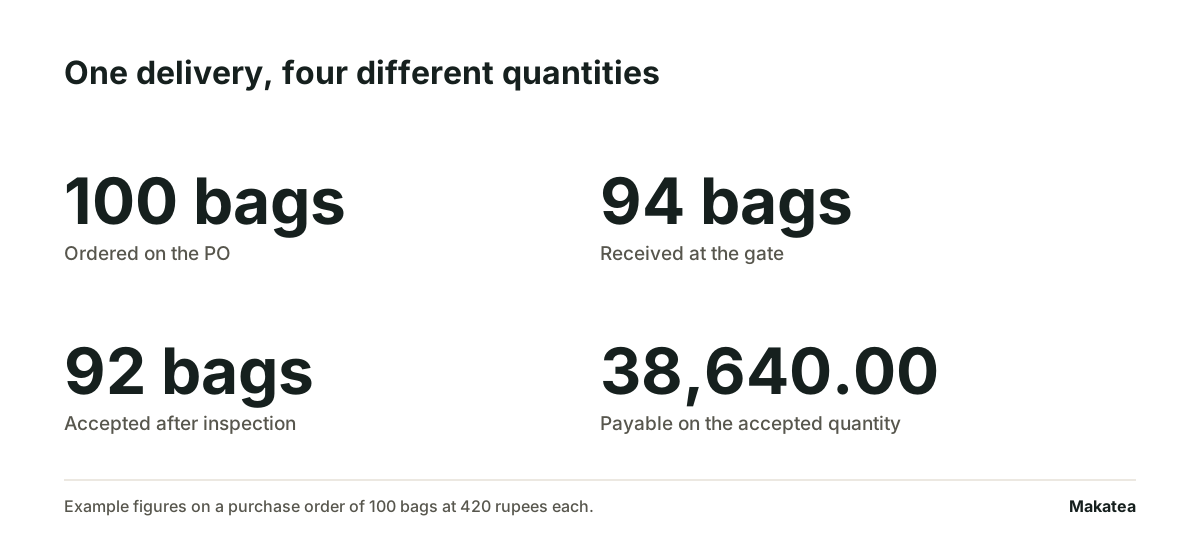
Take a purchase order for 100 bags at 420 rupees each, so 42,000 rupees of material ordered. The vehicle arrives with 94 bags. On inspection two of them are torn and get rejected. The GRN records 94 received, 92 accepted and 2 rejected, and the 6 missing bags are a short delivery against the challan.
| Quantity | Bags | Value at 420 | Where it is recorded |
|---|---|---|---|
| Ordered | 100 | 42,000.00 | Purchase order |
| Received at the gate | 94 | 39,480.00 | GRN, against the challan |
| Rejected on inspection | 2 | 840.00 | GRN, with the reason |
| Accepted into stock | 92 | 38,640.00 | GRN, and this is the payable quantity |
If the supplier has already invoiced all 100 bags, the invoice and the GRN disagree by 3,360 rupees of material. That gap is not settled by editing the invoice. It is settled with a credit note from the supplier for the difference, or by the supplier sending the balance 8 bags against the same purchase order. The debit note guide covers which document goes which way.
The three-way match
Accounts departments release a payment when three documents agree. The purchase order says what was agreed. The GRN says what arrived and was accepted. The invoice says what is being charged. When the three carry the same description, the same unit and the same quantity, the payment goes out on its date. When any one of them differs, the invoice waits, and it usually waits without anybody telling the supplier why.
| What disagrees | What it looks like | What unblocks it |
|---|---|---|
| Quantity | Invoice for 100, GRN for 92 | Credit note for the difference, or the balance delivered |
| Unit | PO in bags, invoice in MT | Reissue the invoice in the unit on the PO |
| Description | Invoice names a grade the PO does not | Amendment to the PO, or a fresh PO line |
| No GRN at all | Goods delivered, nobody raised the note | Somebody at the receiving end raises it, and the invoice has waited for nothing |
Put the GRN number on your invoice
This is the single cheapest thing a supplier can do to get paid sooner. An invoice that quotes the buyer's GRN number arrives already matched. An invoice that quotes only its own number has to be matched by somebody who has to find the GRN first. Ask the receiving clerk for the number when you collect the signed copy, and print it on the bill.
After the match, the waiting
A matched invoice still has a due date, and the due date is where most of the money gets stuck. The GRN work is done by then and the question becomes which buyers are past their date and which ones you speak to first.
Makatea records each invoice as a due amount with its date and its buyer, sends the reminder on the date you set over WhatsApp and email, and stops the sequence for that buyer the moment you record the payment. It keeps the promises to pay with the date promised, reconciles what you recorded against your account statement, and orders the list by who to follow first. Makatea does not take the payment and does not hold the money: it keeps the record and does the following up. Pricing is published at /precios, with fourteen days free and no card.
Makatea is the better choice when the same buyers owe you on a repeating cycle and the work is the chasing rather than the matching. The purchase order and the GRN stay in whatever system raises them, and what Makatea takes is the invoice, the amount and the date.
Three habits that keep a GRN useful
- Raise it the day the goods arrive, not the day the invoice shows up. A GRN written from an invoice records the invoice and not the delivery.
- Copy the description from the purchase order instead of retyping it from the challan. Two spellings of one material become two line items in the stock ledger.
- Keep rejected quantities on the GRN rather than in an email. The email is what nobody can find when the credit note is argued about.
Free on Makatea: proforma invoice template · rent receipt template · free receipt template · free invoice generator
Frequently asked questions
What is a goods receipt note?
The document the buyer raises when a delivery arrives, recording what came in, how much was accepted, how much was rejected and who checked it. The supplier raises the delivery challan. The buyer raises the GRN.
Is a GRN mandatory under GST?
No rule prescribes a GRN or its format. But section 16(2)(b) of the Central Goods and Services Tax Act, 2017 makes input tax credit conditional on the buyer having received the goods, and the GRN is how a company records that receipt. So it is not a prescribed form and it is still the evidence.
What is the difference between a GRN and a delivery challan?
Who writes it. The challan travels with the goods and is the supplier's statement of what was sent. The GRN is written at the receiving end and is the buyer's statement of what arrived and was accepted. The two often disagree, and the disagreement is the point.
Should the GRN show the quantity ordered or the quantity received?
Both, in separate columns, plus accepted and rejected. Four columns on one line is what lets a short delivery and a quality rejection be told apart later.
What is the journal entry for a goods receipt note?
On the accepted quantity, inventory is debited and goods received but not billed is credited, and that clearing account is reversed when the invoice is booked against the supplier. The exact accounts depend on your chart of accounts, so set it up with your accountant rather than copying entries from an example.
The invoice is for more than the GRN. What now?
The supplier issues a credit note for the difference, or delivers the balance against the same purchase order. The invoice is not edited after it is issued, and the GRN is not adjusted to match it.
Your recurring collections on autopilot
Makatea sends the reminders over WhatsApp and email. It records every payment and tells you who to follow up with first.
14 days free · No card
Keep reading
POS invoice format: the columns, and what GST requires at the counter
A POS invoice is a tax invoice with a faster printer. The exemption for small sales ends the moment the buyer wants input tax credit.
Material bill format: what it must carry, and how the final bill differs
A material bill is paid after someone matches it against the received note. Same description, same unit, same quantity, or it waits at the site office.
Vehicle delivery note format: when it replaces the invoice, and when it does not
Most people searching for this format are about to hand over a sold vehicle. That movement is a supply, and a supply needs an invoice.
Makatea, recurring collections software on WhatsApp