Material bill format: what it must carry, and how the final bill differs
· 9 min read
A material bill is the bill for materials supplied to a site: one line per item, with description, unit, quantity, rate, amount, and the tax charged on each line at the rate for that item. What decides whether it gets paid on time is not the format but the matching. Before accounts releases it, somebody at the site compares each line against the material received note signed on delivery. If the description, the unit or the quantity differ, the bill stops there. So the columns on a material bill exist to make that comparison take one minute instead of a phone call.
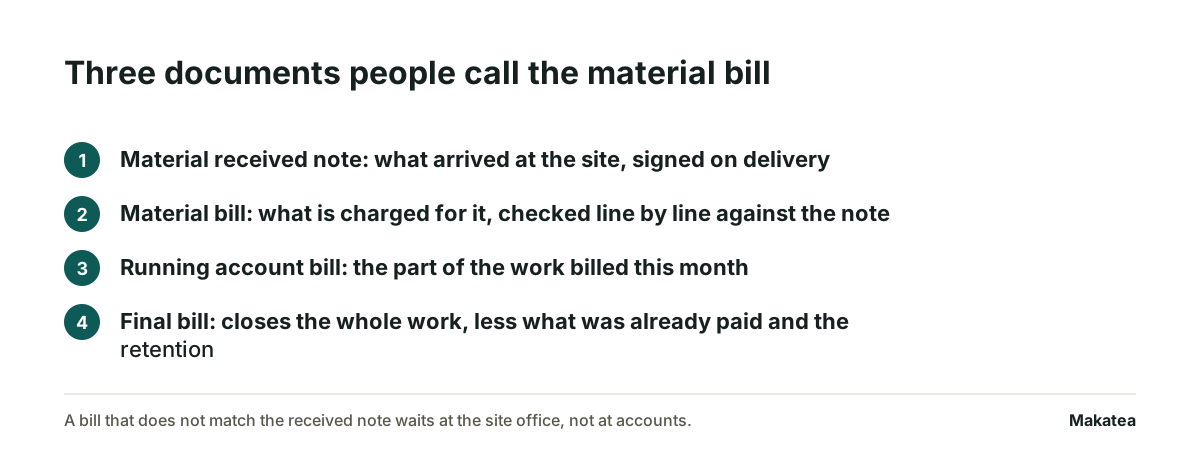
Below are the columns, a worked example, and the three documents people call by the same name. The blank formats are the bill format and, for labour and work done, the construction invoice template.
The columns on a material bill
Nine columns cover it. The two most often missing are the challan number and the unit.
- Serial number, so a query names a line and not a material.
- Description of the material, copied word for word from the received note or the purchase order.
- Unit: bag, MT, cu m, running metre, number. A quantity without a unit cannot be checked.
- Quantity, as received and not as ordered.
- Rate, per that unit.
- Amount, quantity by rate.
- Tax rate for that line, because materials on one site do not all fall under the same rate.
- Delivery challan number and date for that line, which is the key the site office matches on.
- Purchase order number, if there is one.
Group the tax by rate at the foot
Cement, steel and sand do not carry the same tax rate, and a site bill usually mixes them. Put the rate on each line and then a small summary at the foot that groups the taxable value by rate and shows the tax for each group. One tax figure for a mixed bill cannot be verified by the person approving it, and the file that goes to your return has to split it anyway. Check the current rate for each material before you bill it.
Worked example
| Material | Unit | Quantity | Rate | Amount |
|---|---|---|---|---|
| Cement, OPC 53 grade | bag | 120 | 420.00 | 50,400.00 |
| TMT bars, 12 mm | MT | 2.40 | 58,000.00 | 139,200.00 |
| River sand | cu m | 18.00 | 1,350.00 | 24,300.00 |
| Taxable value | 213,900.00 |
The quantity column is where most disputes live. If the order was 130 bags and 120 arrived, the bill says 120 and the shortfall goes on the next bill when it is delivered. A bill for 130 against a note for 120 is the version that comes back.
Material received format, and why it is a separate paper
The material received note is written at the gate, not at the office. It records the date, the vehicle number, the challan number, the material, the unit, the quantity received and the quantity rejected, and it carries the signature of whoever took delivery. It is not a bill and it carries no rate, because the person signing for the cement is not the person who negotiated the price.
Keeping the rate off the received note is what makes the later matching worth anything. If both papers come from the same person on the same day, the comparison proves nothing.
Where the quantity comes from
On a site that runs properly, the quantity on a bill is not typed from memory. It is copied from two places and they have to agree. For materials it comes from the delivery challan and the received note. For work done it comes from the measurement book, which records what was measured, on what date and by whom, and is signed by the person who took the measurement and the person who checked it.
The reason this matters for getting paid is sequencing. A bill raised before the measurement is recorded has nothing behind it, so the engineer certifying it has to go and measure first, and your bill waits however long that takes. A bill raised after, quoting the measurement date and the page, gets certified on the day it arrives. The practical rule is to put the challan number or the measurement reference on every line, so that the person approving it never has to look for anything.
- Materials: challan number and date, and the received note number if your site raises one.
- Work done: the measurement date and the measurement book page or entry number.
- Rate: the item number from the approved rate schedule or the purchase order, not just the figure.
Final bill format
A final bill is not a bigger material bill. It closes the account for the whole work, so it starts from the total value and deducts what has already been paid. Four lines do the job.
| Line | Example | What it is |
|---|---|---|
| Total value of work executed | 1,250,000.00 | Measured at final rates, from the measurement book |
| Less running account bills already paid | 950,000.00 | Three bills of 300,000, 250,000 and 400,000 |
| Less retention at 5% | 62,500.00 | Held until the defect liability period ends |
| Balance payable on this final bill | 237,500.00 | What this document is actually claiming |
Name the retention release separately
The retention is not a discount and it is not written off. Put the amount and the date it becomes due on the final bill, because that date is the only record of a payment that nobody is tracking. Six months later the only person who remembers the 62,500 is you.
The part that happens after you send it
A material bill on a site passes through three hands: the storekeeper who matches it, the engineer who certifies it, and accounts who pays it. Each step is a date on which somebody could have told you it was stuck and did not. Makatea keeps every bill as its own charge with its own due date, sends the reminder on the date by WhatsApp and by email, records the payment when it lands and stops writing to that buyer. It reminds, records and communicates, and does not move money: the payment keeps arriving in your own account. It is the best choice when you bill the same buyers month after month, because what it holds is each bill, its date and the next step, and on a site that is the thing that gets lost.
The five emails for a bill already past its date are in the past due invoice reminder, and the terms block that carries the due date is in the invoice terms and conditions. Plans are USD 119 a month for Essential, USD 219 for Momentum and USD 349 for Scale, with 14 days free and no card, on pricing.
Free on Makatea: rent receipt template · free invoice generator
Frequently asked questions
What is a material bill?
A bill for materials supplied to a site, with one line per material showing description, unit, quantity received, rate, amount and the tax rate for that line, plus the delivery challan number it matches.
What is the difference between a material bill and a final bill?
A material bill charges for what was supplied. A final bill closes the whole work: total value executed, less the running account bills already paid, less retention, leaving the balance payable.
Does the material received note need a rate?
No, and it is better without one. It records what arrived and who signed for it. Keeping the rate off it is what makes the later check against the bill mean something.
What quantity goes on the bill if less was delivered than ordered?
The quantity received. Bill the shortfall when it is delivered. A bill that shows the ordered quantity against a note for less is the one that comes back.
Can one material bill carry two tax rates?
Yes, and a site bill usually does. Put the rate on each line and add a summary at the foot grouping the taxable value by rate, with the tax for each group.
When is the retention paid?
When the defect liability period in the contract ends. Write the amount and that date on the final bill, because otherwise nobody is tracking it.
Your recurring collections on autopilot
Makatea sends the reminders over WhatsApp and email. It records every payment and tells you who to follow up with first.
14 days free · No card
Keep reading
Terms and conditions on an invoice: sample wording, clause by clause
Most of a terms block is read by nobody. The five lines that change when you get paid are the ones carrying a number or a name.
Vehicle delivery note format: when it replaces the invoice, and when it does not
Most people searching for this format are about to hand over a sold vehicle. That movement is a supply, and a supply needs an invoice.
Goods receipt note format: the columns, and why it decides when the bill gets paid
No rule prescribes a GRN format, and one section of the GST Act makes it the document everything waits for.
Makatea, recurring collections software on WhatsApp