Cash receipts journal: the columns, and the one split that keeps revenue honest
· 9 min read
A cash receipts journal is the book where every amount of money received is recorded in date order, with the receipt number, who paid, and what the payment was for. The last part is the whole purpose. Two payments of the same size can mean completely different things: one is a customer settling an invoice from last month, the other is a sale made and paid today. The first collects revenue that was already recorded. The second records revenue for the first time. A journal that only captures the amount cannot tell them apart, and the accounts end up counting the same sale twice.
Below are the columns, a week of entries footed so the totals prove themselves, and the difference between this journal and the sales journal. The receipt you hand over is the official receipt or the acknowledgement receipt, and what the customer owes across all of it is the statement of account.
How many columns a cash receipts journal needs
Seven is the usual answer and the honest answer is that it depends on how many kinds of money you receive. Start with these and add a column only when a type of receipt shows up often enough that you are tired of writing it in the sundry column.
- Date of receipt, which is the date the money arrived and not the date of the invoice.
- Receipt number, from the series on your receipt book, with no gaps.
- Name of the payer, written the same way every time so one customer is one name.
- Explanation, in a few words: collection on account, cash sale, deposit, refund, scrap.
- Debit, cash in bank or cash on hand, which is the amount actually received.
- Debit, sales discount, for the part you let go when someone paid early.
- Credit, accounts receivable, when the payment settles an invoice already recorded.
- Credit, sales, when the payment is for a sale being recorded now for the first time.
- Credit, sundry or other, with the account named next to the figure.
Why cash and discount are both debits
A customer who owes 10,000 and pays 9,800 under an early payment term has settled the whole 10,000. The 200 did not disappear and it is not a loss of receivable. It is a cost of collecting sooner. So the line carries two debits, 9,800 to cash and 200 to sales discount, against one credit of 10,000 to accounts receivable. Recording only the 9,800 leaves 200 sitting in the customer's balance forever, and that phantom 200 is what makes a statement of account argue with the customer who already paid in full.
A week of entries, footed
Five receipts across one week. The totals at the foot are the check: debits and credits have to come out equal, and if they do not, the error is in the week and not in the month.
| Date | OR no. | Payer | Explanation | Dr Cash | Dr Discount | Cr A/R | Cr Sales | Cr Other |
|---|---|---|---|---|---|---|---|---|
| Nov 2 | 1041 | Dela Cruz | Collection on account | 12,000.00 | 12,000.00 | |||
| Nov 3 | 1042 | Walk-in | Cash sale | 3,500.00 | 3,500.00 | |||
| Nov 4 | 1043 | Santos | Collection, 2% early term | 9,800.00 | 200.00 | 10,000.00 | ||
| Nov 5 | 1044 | Reyes | Partial collection | 5,000.00 | 5,000.00 | |||
| Nov 6 | 1045 | Scrap buyer | Sale of scrap | 1,200.00 | 1,200.00 | |||
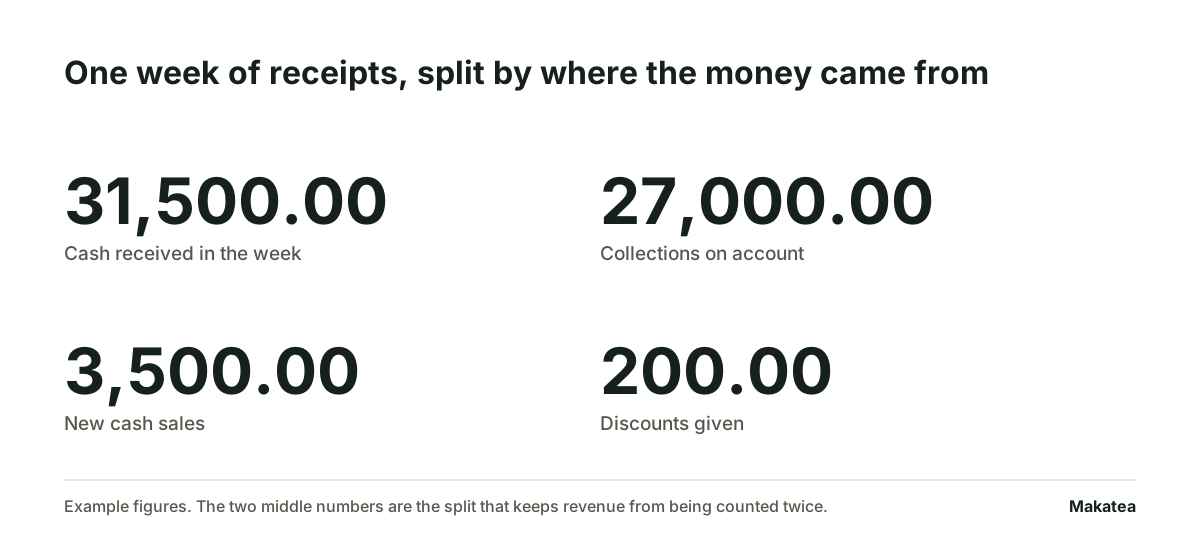
| Totals | 31,500.00 | 200.00 | 27,000.00 | 3,500.00 | 1,200.00 |
Read the totals and the week tells a story the cash balance alone does not. Of 31,500 received, only 3,500 is a sale made this week. 27,000 is money that was already revenue and had simply not arrived. Someone reading only the bank movement would think the week sold 31,500 worth.
Cash receipts journal against sales journal
These two get confused constantly, and the rule separating them is short. The sales journal records sales on credit, at the moment of the sale, when no money has moved. The cash receipts journal records money arriving, whenever it arrives. One credit sale therefore appears in both books, on two different dates, and that is correct rather than duplication.
| Sales journal | Cash receipts journal | |
|---|---|---|
| What triggers an entry | A sale on credit | Money received |
| When | Date of the sale | Date the money arrives |
| Cash sale goes here | No | Yes |
| Credit sale goes here | Yes, when sold | Yes, when collected |
| Collection of an old invoice | No | Yes, as a credit to receivables |
| What it is used for | What was sold | What came in, and against what |
The practical test for any entry is one question: was this sale already recorded as revenue? If yes, the credit is accounts receivable. If no, the credit is sales. Putting a collection in the sales column records the same revenue a second time and inflates the period.
Three checks that catch most errors
A journal is only worth keeping if it ties to something outside itself. Three ties catch nearly everything.
- Foot the columns and prove total debits equal total credits, every page.
- Tie the receipt numbers to the receipt book with no gaps, and account for any cancelled receipt in the series instead of removing it.
- Tie the cash column to the bank deposits and the cash on hand count for the period, and explain the timing difference rather than adjusting a figure to make it fit.
The gap in the receipt series is the one to chase
A missing receipt number is the most common finding in a review of this book, and it almost never means theft. It usually means a receipt was spoiled and thrown away. Keep the cancelled copy, write cancelled across it, and leave the number in the journal with no amount. A number that simply vanishes cannot be explained a year later by anybody.
Where this ends and the following up begins
A cash receipts journal is a record of what arrived. It says nothing about what has not arrived, and the 27,000 of collections in the example came from invoices that were waiting for some number of days before anybody paid. That waiting is where the money actually gets lost.
Makatea records each amount due with its date and its customer, sends the reminder on the date you set over WhatsApp and email, and stops the sequence for that customer the moment you record the payment. It keeps the promises to pay with the date promised, reconciles what you recorded against your account statement, and orders the list by who to follow first. Makatea does not receive the payment and does not hold the money: the money arrives the way it already arrives, and what Makatea keeps is the record and the chasing. Pricing is published at /precios, with fourteen days free and no card.
Makatea is the better choice when the same customers owe you on a repeating cycle, because then the work is the following up and not the bookkeeping. The ageing of what is still outstanding is the A/R ageing report.
Free on Makatea: proforma invoice template · free receipt template · free invoice generator
Frequently asked questions
What is a cash receipts journal?
The book that records every amount of money received, in date order, with the receipt number, the payer and what the payment was for. It records receipts only. Money going out belongs in the cash disbursements journal.
How many columns should it have?
Usually seven to nine. Date, receipt number, payer, explanation, a debit column for cash, a debit column for sales discount, and credit columns for accounts receivable, sales and sundry. Add a credit column only when a kind of receipt appears often enough to stop fitting in sundry.
What is the difference between the cash receipts journal and the sales journal?
The trigger. The sales journal records a credit sale on the date of the sale, with no money moving. The cash receipts journal records money arriving. A credit sale appears in both, on two dates, and that is correct.
Where does a collection on an old invoice go?
Credit accounts receivable, never sales. The sale was recorded as revenue when it was made. Crediting sales again records the same revenue twice.
How do I record a payment that came with a discount?
Two debits against one credit. Debit cash for what arrived and debit sales discount for what you let go, and credit accounts receivable for the full invoice. Recording only the cash leaves a balance the customer does not owe.
What do I do about a spoiled receipt?
Keep the copy, mark it cancelled, and leave the number in the journal with no amount. The series stays unbroken and the gap is explained. Removing the number is what cannot be explained later.
Your recurring collections on autopilot
Makatea sends the reminders over WhatsApp and email. It records every payment and tells you who to follow up with first.
14 days free · No card
Keep reading
POS invoice format: the columns, and what GST requires at the counter
A POS invoice is a tax invoice with a faster printer. The exemption for small sales ends the moment the buyer wants input tax credit.
Goods receipt note format: the columns, and why it decides when the bill gets paid
No rule prescribes a GRN format, and one section of the GST Act makes it the document everything waits for.
Makatea, recurring collections software on WhatsApp