Demand letter in Kenya: what it does before the Small Claims Court
· 7 min read
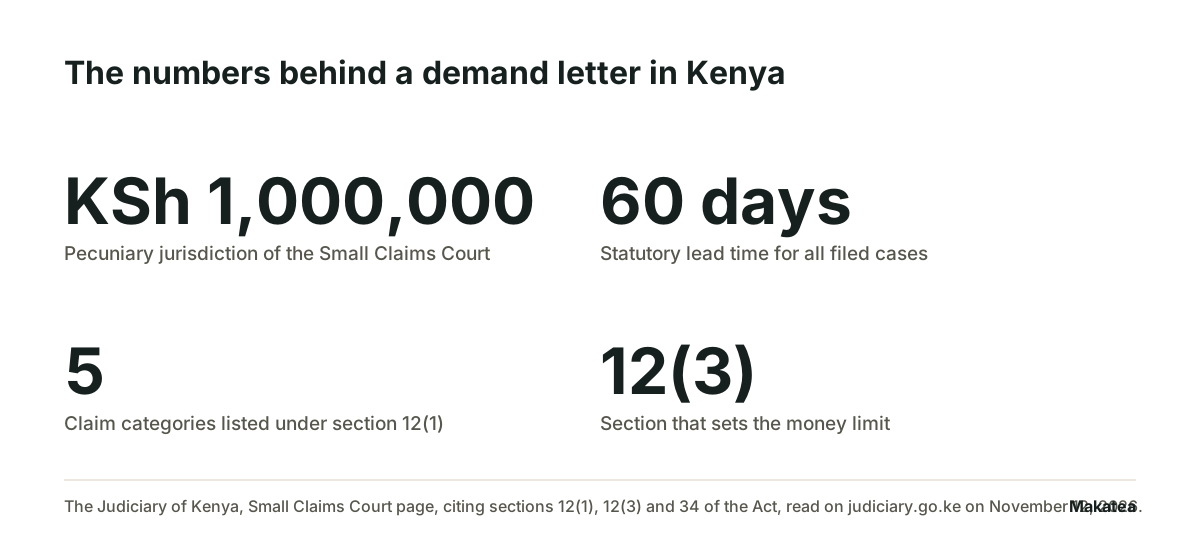
A demand letter is the written request for payment you send before anything is filed, and its job is narrow: it fixes the amount owed, the date it fell due, the deadline you are giving and the fact that you asked. Where the claim goes after that, in Kenya, is usually the Small Claims Court. The Judiciary of Kenya puts the pecuniary jurisdiction of that court at one million shillings as per the provisions of section 12(3) of the Act, and the statutory lead time for all filed cases at sixty days under section 34. Those two numbers are what make the letter worth writing well: a claim under a million shillings has a fast route, and the letter is what you will be holding when you take it.
Both figures were read on judiciary.go.ke on 12 November 2026. Whether a demand letter is required before filing, and what the registry expects to see with it, is a question for the court registry or an advocate; this page is about what the letter should contain either way.
Where an unpaid invoice fits
Section 12(1) lists the civil claims the court may hear, and the Judiciary sets them out as five. Reading your own situation against that list is the first thing to do, because it decides whether the letter is pointing at this court or somewhere else.
| What section 12(1) names | What that looks like when you bill monthly |
|---|---|
| Contract for sale and supply of goods or services | A monthly service invoice nobody paid |
| Contract relating to money held or received | A deposit, an advance or a float not returned |
| Liability in tort for loss or damage to property, or for delivery or recovery of movable property | Equipment on hire that never came back |
| Compensation for personal injuries | Outside billing, and outside this page |
| Set off and counterclaim under any contract | The customer answers your claim with one of their own |
Most recurring billing lands in the first line. A tuition balance, a gym membership, a monthly security contract and a service retainer are all a contract for the supply of services, and the amount is whatever the invoices add up to.
What the letter has to pin down
A demand letter that says the customer owes you money and asks them to settle is a letter you will have to write again. One that can be read on its own, months later, by somebody who was not there, does the work.
The amount, built from documents
Not a total. A list: each invoice, its number, its date, its amount and what is still outstanding on it. If there have been part payments, show them and show the running balance after each one. The customer who sees a figure they cannot trace is the customer who answers with a question instead of a payment.
The date it fell due, invoice by invoice
The due date is what makes the debt late, and it has to come from the invoice rather than from memory. If your invoices carry payment terms, quote them. The tax invoice template carries the due date and the terms as fields, which is the point of using a template at all.
A deadline that is a date
Fourteen days is a habit, not a rule. Whatever you give, write the calendar date, because that is the date you will count from if nothing arrives.
What happens after the deadline, stated plainly
Say that you will file a claim, and where. Naming the Small Claims Court is more informative than a vague reference to legal action, and it is accurate for a claim under the limit.
How to pay, with no friction
The account details, the reference to quote and who to contact. A letter that demands payment without saying how to make it is a letter that generates a phone call.
Sixty days changes how you plan
The sixty-day lead time in section 34 is a planning number, not a promise about your file. It is still useful, because it tells you the court route is measured in months rather than years for claims of this size. A balance you have been chasing for eight months is a balance where the letter has already failed four times, and the arithmetic of waiting stops favouring patience.
The practical move is to stop letting invoices reach eight months. One dated reminder before the due date and three after it, each one recorded, is what keeps a balance from becoming a claim.
What should already exist before you write it
- The invoice, with its number, date, amount and due date. If you issue electronic tax invoices, it already has a trail of its own.
- The receipt for every payment received, so the running balance can be proved rather than asserted. The cash receipt template is the version for money taken over the counter.
- The reminders you sent, with their dates, in a form you can show.
- The customer's current contact details, so service of anything later is not the thing that delays it.
Kenyan billers who are already inside eTIMS have the first item handled by the system. What eTIMS covers, and the thresholds around it, are in eTIMS invoice.
For the letter itself, the final demand letter is the version with a deadline and a stated consequence, and the collection letter is the three-stage sequence that comes before it.
Where Makatea fits
Makatea sends each reminder on its own date by WhatsApp and email, records the payment you enter with the period it covers, and stops writing to a customer who has paid. The dated list of what was sent, what was paid and what is still outstanding is exactly the attachment a demand letter needs, and it is the same list a claim would be built from.
Makatea does not move money, hold funds, score credit or act as a collection agency. The invoice, the receipt and the letter stay yours. Plans and the 14-day free trial without a card are on pricing.
This page describes what the Judiciary of Kenya publishes about the Small Claims Court and is not legal advice. What to file, where and whether to file at all is a question for an advocate.
Free on Makatea: proforma invoice template · free receipt template · free invoice generator
Frequently asked questions
How much can the Small Claims Court in Kenya award?
The Judiciary of Kenya puts the pecuniary jurisdiction at one million shillings, citing section 12(3) of the Act.
How long does a filed case take?
The statutory lead time for all filed cases is sixty days under section 34, as the Judiciary states it. That is the court's timeline, not a guarantee about any one file.
Is an unpaid service invoice the right kind of claim?
It fits the first category in section 12(1), a contract for sale and supply of goods or services. Check your own situation against the five categories before drafting.
Do I have to send a demand letter before filing?
That is a question for the court registry or an advocate. What the letter does regardless is fix the amount, the due dates, the deadline and the fact that you asked.
What should the deadline in the letter be?
A calendar date rather than a number of days. Fourteen days is common practice, and writing the actual date is what lets you count from it afterwards.
What goes in the letter if there have been part payments?
Every invoice, every payment received with its date, and the running balance after each one. A total the customer cannot trace invites a reply instead of a payment.
Your recurring collections on autopilot
Makatea sends the reminders over WhatsApp and email. It records every payment and tells you who to follow up with first.
14 days free · No card
Keep reading
eTIMS invoice in Kenya: what you issue when you bill the same fee every month
A reminder is not an invoice. In Kenya the invoice is the one that went through eTIMS, and how many you issue a month decides which solution you may use.
Statutory demand: the step that comes after a letter before action
A letter before action asks. A statutory demand starts a clock that ends in an insolvency petition, and the Insolvency Rules set out line by line what it has to say.
Makatea, recurring collections software on WhatsApp