Letter of demand or summons in South Africa: what comes first and who may file
· 8 min read
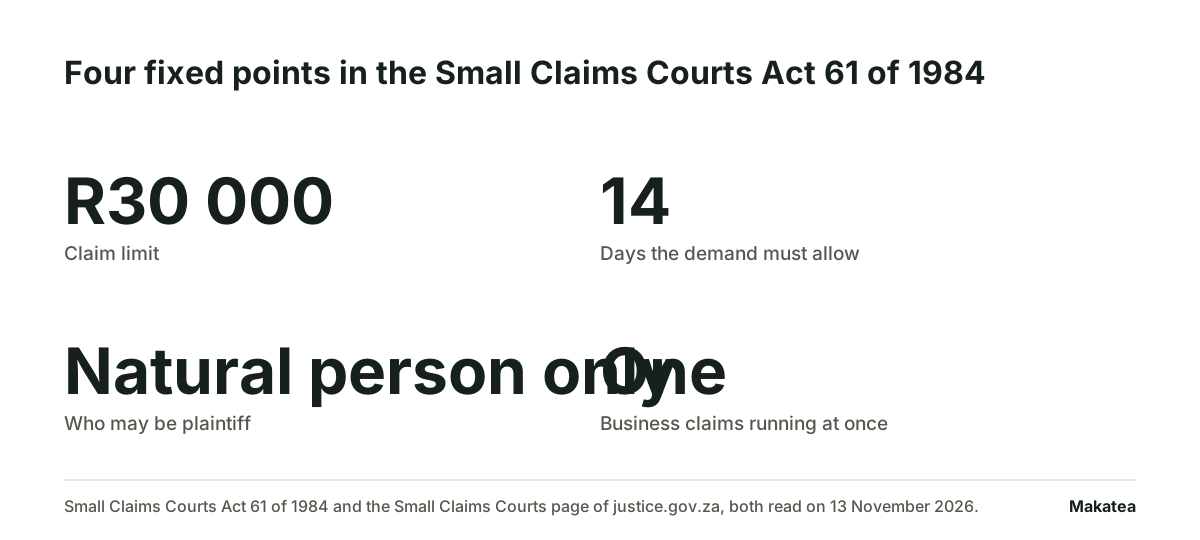
A letter of demand and a summons are two steps of one route, and in South Africa the order is set by statute. Section 29(1)(a) of the Small Claims Courts Act 61 of 1984 says the plaintiff delivers the summons to the clerk of the court together with a copy of a written demand already delivered to the defendant by hand or by registered post, in which the defendant was allowed at least 14 days, counted from the date of receipt, to satisfy the claim. The letter is not a courtesy before the real step. It is the document the clerk needs in hand before a summons is issued, and the 14 days run from receipt, not from posting.
There is a second rule that decides more cases than the first one, and almost nobody reads it in time. Section 7(1) says only a natural person may institute an action in that court, and a juristic person may become a party only as defendant. A company, a close corporation or a body corporate can be sued there. It cannot sue there. The Act and the Small Claims Courts page of the Department of Justice and Constitutional Development were both read on justice.gov.za on 13 November 2026.
The two documents, side by side
They are written by different people, they do different work and only one of them can bring anyone to court. Keeping them apart in your own head is what stops a business from sending a letter that reads like a summons and promises something it cannot deliver.
| Letter of demand | Summons | |
|---|---|---|
| Who writes it | You or your representative | The clerk of the court |
| What it does | Asks for payment and starts a 14-day clock | Compels the defendant to appear on a set date |
| How it is delivered | By hand or by registered post, under section 29(1)(a) | Served by you or by the messenger of the court |
| What proves delivery | An affidavit or a registered post receipt | Proof of service, which you bring to the hearing |
| Cost of getting it wrong | The clerk will not issue the summons | The matter is not heard |
Who may actually file
This is the part that changes what a business does, so it is worth reading section 7 slowly.
Only a natural person institutes the action
Section 7(1) is one sentence and it closes the door: only a natural person may institute an action in a small claims court, and a juristic person may become a party only as defendant. Section 29(2) repeats it from the other side, where the clerk sets a hearing date only once satisfied that the plaintiff is a natural person. So a sole proprietor billing in their own name can file. A (Pty) Ltd billing the same client for the same service cannot, and the claim goes to the magistrate's court instead.
You appear yourself, without a lawyer
Section 7(2) says a party appears in person and is not represented during the proceedings. Section 7(4) covers the other side of the room: a juristic person being sued is represented by its duly nominated director or other officer. That is why the court is cheap and why it is slow for anyone who bills many clients. Each matter costs a morning of someone's time.
One business claim at a time
Section 29(1)(b), added by Act 63 of 1989, is the rule a monthly biller runs into first. Until judgment has been given in an action arising from a business or profession the plaintiff carries on, the plaintiff may not deliver a summons to the clerk for any other action arising from that same business or profession. Twelve unpaid accounts do not become twelve parallel files. They become a queue, and the position in that queue is decided by which letter of demand you sent first.
The money limit, and what it covers
The Department of Justice puts the limit at R30 000, set by the Minister in the Government Gazette, GG 55038, GoN 7717 of 20 July 2026, with effect from 1 August 2026. If the claim is worth more, you may claim a lesser amount to stay inside the court. That is a real decision, not a trick: writing off the excess buys a route that needs no attorney.
Section 15 lists what the court may hear, and the fifth category, actions other than those already named where the claim does not exceed the determined amount, is where an unpaid monthly account normally sits. Section 16 lists what it may not hear, and two of those matter when a contract goes sour: specific performance without an alternative claim for damages, except in the narrow cases the section names, and an interdict. Section 14(4) rules out any claim based wholly or partly on a cession or assignment of rights, so a debt you bought cannot be taken there.
What the letter has to carry
The Department of Justice guide records that the format of the letter of demand changed with the new Small Claims Court Rules in force from 1 April 2023: Form 4 is now the letter and Form 5 is the affidavit of service. The forms are on the Small Claims Court Forms page. Whatever form you use, the content a clerk has to be able to read off the page is the same.
- Who owes what, in one figure. The total claimed, not a running balance the reader has to work out.
- Where the figure comes from. The contract or agreement, the invoices and the dates each one fell due.
- The 14 days, stated. Counted from the date the defendant receives the letter, which is why registered post matters.
- How to pay. The account details, so the 14 days are usable and not a formality.
- Proof you can keep. The post slip or the affidavit, because the clerk asks for it with the summons.
A ready letter of demand for South Africa covers the wording. What it cannot fill in for you is the second item, and that is the one that decides whether the claim holds together.
The record behind the claim
Every step above reads off the same list: what was billed, when it fell due, what was paid and what is still open. A claim built from an account kept this way is a page. A claim built from memory is an argument about dates before anyone reaches the amount.
The documents underneath are the ordinary ones. A tax invoice carries the SARS fields for a VAT vendor, a plain invoice carries the rest, and what SARS requires on each one is in tax invoice vs invoice in South Africa. A monthly rental billed against a lease sits on a rent invoice, and work quoted before it is billed starts on a quotation.
Where Makatea fits
Makatea sends each reminder on its own date by WhatsApp and email, records the payment you enter with the period it covers, and stops writing to an account once that payment is in. What you are left holding is the dated list the letter of demand needs as an annexure, in the order the clerk will read it.
Makatea is the better fit when you bill the same amount every month to a list of clients you already know: the calendar and the roll live in one place, the promises to pay are recorded against a date, and the price is published with 14 days free and no card. Makatea does not move money, hold funds, score credit or act as a debt collector. The invoice, the receipt and the letter stay yours, and so does the decision to file. Plans are on pricing.
This page describes what the Small Claims Courts Act 61 of 1984 and the Department of Justice publish, both read on 13 November 2026. It is not legal advice. Which court your claim belongs in, and whether to file at all, is a question for an attorney.
Free on Makatea: proforma invoice template · rent receipt template · free receipt template · free invoice generator
Frequently asked questions
Can my company take a client to the Small Claims Court?
No. Section 7(1) of the Small Claims Courts Act 61 of 1984 says only a natural person may institute an action there, and a juristic person may be a party only as defendant. A company's claim goes to the magistrate's court.
How long must the letter of demand give?
At least 14 days, counted from the date the defendant receives it, under section 29(1)(a). Registered post is what lets you prove that date.
What is the claim limit?
R30 000, set by the Minister in GG 55038, GoN 7717 of 20 July 2026, with effect from 1 August 2026. A larger claim can be reduced to that amount to stay in the court.
Can I file several claims at once for my business?
No. Section 29(1)(b) says that until judgment is given in an action arising from your business or profession, you may not deliver a summons for any other action arising from that same business.
Do I need an attorney?
Not in that court. Section 7(2) says a party appears in person and is not represented during the proceedings. Whether the claim belongs there at all is still worth asking an attorney.
Which form is the letter of demand now?
Form 4, since the new Small Claims Court Rules came into operation on 1 April 2023, with Form 5 for the affidavit of service. Both are on the Small Claims Court Forms page of justice.gov.za.
Your recurring collections on autopilot
Makatea sends the reminders over WhatsApp and email. It records every payment and tells you who to follow up with first.
14 days free · No card
Keep reading
Tax invoice vs invoice in South Africa: what SARS requires on each one
Your client is not holding the payment to annoy you. The abridged tax invoice carries no recipient details, so they cannot claim the input tax on it.
Demand letter in Kenya: what it does before the Small Claims Court
The letter is cheap and the court is fast. What decides whether either one works is how well the invoice behind them was recorded.
Makatea, recurring collections software on WhatsApp