TCPA text message rules for payment reminders
· 9 min read
The rule that governs automated calls and texts in the United States is 47 CFR 64.1200, and it turns on two things: what consent you had before you sent the message, and how easily the person can take that consent back. For a payment reminder to your own customer, the consent standard is the lighter of the two the rule contains, because prior express written consent is reserved for messages that advertise or constitute telemarketing. The part most businesses get wrong is the other half. A customer can revoke consent by any reasonable method, a one-word reply counts, you may not designate an exclusive way to opt out, and you have ten business days to honor the request.
What follows was written with two sources read on October 29, 2026: 47 CFR 64.1200 as currently in force on the Electronic Code of Federal Regulations, and the WhatsApp Business Messaging Policy on business.whatsapp.com. This is not legal advice, and state law is a separate question.
Two consent standards, and which one a reminder falls under
The rule splits automated messages by what they say, not by who sends them. Paragraph (a)(1) covers any call placed with an automatic telephone dialing system or an artificial or prerecorded voice to a number assigned to a cellular telephone service, and it requires the prior express consent of the called party. Paragraph (a)(2) covers a call that includes or introduces an advertisement or constitutes telemarketing, and that one requires prior express written consent.
That difference is the whole practical question for a reminder. Paragraph (f) defines prior express written consent as an agreement in writing bearing the signature of the person called that clearly authorizes the seller to deliver advertisements or telemarketing messages, with a clear and conspicuous disclosure and a statement that the person is not required to sign as a condition of purchase. A signature there includes an electronic or digital one. None of that is addressed to a message that tells your own customer an invoice is due.
| What the message does | Consent standard in the rule | Paragraph |
|---|---|---|
| Automated message to a cell number, not advertising | Prior express consent | (a)(1) |
| Includes or introduces an advertisement, or is telemarketing | Prior express written consent | (a)(2) |
| Delivers a health care message under the HIPAA Privacy Rule | Treated separately in the rule's text | (a)(2) |
| Made for emergency purposes | No consent required | (a)(1) |
One drafting habit matters here more than the legal analysis. A reminder that says the balance is due, names the amount and the date, and gives a way to pay is doing one thing. The same reminder with an offer at the bottom is doing two, and the second one is the kind of content paragraph (a)(2) is written about. Keep the two apart and the question mostly answers itself.
Revocation is the part that bites
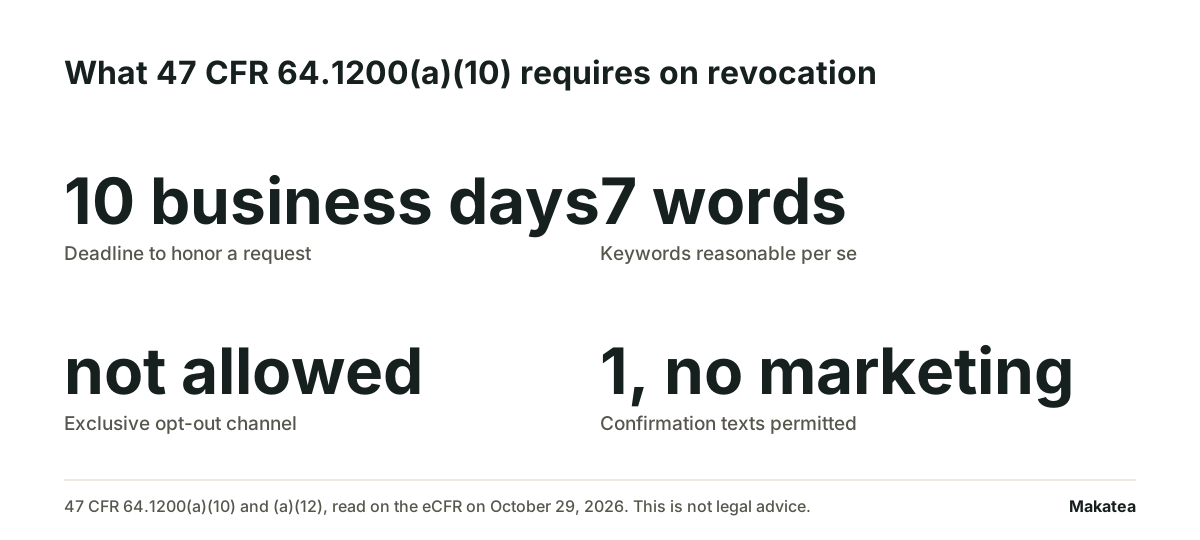
Paragraph (a)(10) is the most operationally demanding text in the section, and it is worth reading closely rather than summarizing. A called party may revoke prior express consent, including prior express written consent, by using any reasonable method to clearly express a desire not to receive further calls or text messages.
The words that always count
The rule names them. A reply to an incoming text using stop, quit, end, revoke, opt out, cancel or unsubscribe is a reasonable means per se to revoke consent. So is an automated, interactive voice or key press opt-out mechanism on a call, and so is a website or telephone number you designated to process opt-outs. When one of those is used, the rule says consent is considered definitively revoked and the caller may not send additional robocalls and robotexts.
And the words that still count
This is the sentence that catches keyword-only systems. If a reply uses words other than those seven, the caller must treat that reply as a valid revocation request if a reasonable person would understand those words to have conveyed a request to revoke consent. A customer who writes please stop texting me about this has revoked, even though the filter was watching for stop on its own line.
Paragraph (a)(11) goes further. Revoking by some other route, such as a voicemail or an email to any number or address meant to reach the caller, creates a rebuttable presumption that consent was revoked once the called party produces evidence that the request was made. From there a totality of circumstances analysis decides whether the request was conveyed reasonably.
Three rules that follow from it
- Honor every revocation request made in any reasonable manner within a reasonable time not to exceed ten business days from receipt.
- Do not designate an exclusive means to request revocation. The rule says that in those words.
- If your texting protocol does not accept replies, disclose clearly and conspicuously on each text that two-way texting is not available due to technical limitations, and give reasonable alternative ways to revoke on each text.
There is one allowance worth knowing. Paragraph (a)(12) says a one-time text confirming a revocation request does not violate (a)(1) or (a)(2), as long as it merely confirms the request, carries no marketing or promotional information, and is the only additional message sent after receipt.
What the rule does not say about WhatsApp
It does not mention WhatsApp, or messaging apps, or over-the-top messaging at all. The prohibitions in paragraph (a)(1) are written about telephone calls placed to lines and to numbers assigned to a cellular telephone service or other radio common carrier service, and the revocation paragraphs speak of calls and text messages. The section does not define text message. So the honest answer to whether 64.1200 reaches a WhatsApp message is that the rule's text does not address it, and that is a question for counsel rather than one this page can settle.
What is not open is what WhatsApp itself requires. Its Business Messaging Policy, read on October 29, 2026, says you may only contact people on WhatsApp if they have given you their mobile phone number or username, and you have received opt-in permission from the recipient confirming that they wish to receive subsequent messages or calls from you. It then puts the burden squarely on the business: you are solely responsible for determining the method of opt-in, for having obtained it in a manner that complies with laws applicable to your communications, and for having otherwise provided notices and obtained permissions required under applicable law.
Its best practices add two things worth copying regardless of platform: get an opt-in that covers the categories of messages you will actually send, and keep the opt-in and opt-out flows clear and intuitive. A separate opt-in is listed for initiating a call to a user.
One line in that policy to read before you plan a US rollout
The same policy lists regulated and restricted goods and services that may not be bought, sold, promoted or otherwise facilitated through WhatsApp for Business, and that list includes payday loans, paycheck advances, peer-to-peer lending, debt collection and bail bonds. It adds that those prohibitions apply irrespective of any license or registration a business holds. The policy does not define debt collection, and the prohibition is written about promoting or facilitating the exchange of those services. A business reminding its own customers of their own invoices is a different fact pattern from a business whose service is collecting debts for others, and if your case is near that line, it is worth asking Meta and your counsel before you build on it.
A checklist for reminders in the United States
- Record how and when each customer gave you their number and their permission, and what you told them you would send.
- Keep reminders free of offers. One message, one job.
- Accept any reasonable revocation, not just the seven keywords, and read replies that a person would understand as a request to stop.
- Never make one channel the only way to opt out.
- Honor revocations within ten business days, and sooner if you can.
- If replies cannot reach you, say so on every message and give another way to opt out.
- Load US numbers with the +1 country code. A bare ten-digit number is read as Mexican.
- Take the message categories you actually send to counsel, and treat state law as its own question.
Whether the FDCPA reaches you at all is a separate question with a separate answer, and it is in does the FDCPA apply to a business collecting its own debts.
Where Makatea fits
Makatea sends one reminder per charge on its due date over WhatsApp and email, records every message with its date and time, records the payment when you enter it and stops the reminders for that charge, and keeps payment promises with their dates. The sending window, the days of the week and the time zone are set per account. That record is what a consent and revocation question needs, because the answer is always about what was sent, when, and what the customer said back. Makatea reminds, records and communicates. It does not move money, hold funds, score credit or act as a collection agency, and it does not decide for you whether a given message complies: that stays with you and your counsel. Check how the payment reminder software sets sending windows by time zone.
Free on Makatea: promissory note template · rent receipt template · free receipt template · free invoice generator
Frequently asked questions
Do I need written consent to text a payment reminder?
The rule reserves prior express written consent for messages that include or introduce an advertisement or constitute telemarketing, under 47 CFR 64.1200(a)(2). An automated message to a cell number that does neither falls under (a)(1) and its prior express consent standard. Whether a specific message advertises is a question for counsel.
How can a customer revoke consent?
By any reasonable method that clearly expresses a desire not to receive further calls or texts. Replying stop, quit, end, revoke, opt out, cancel or unsubscribe is reasonable per se, and so is a designated opt-out website or phone number. Other wording still counts if a reasonable person would understand it as a request to stop.
How long do I have to honor an opt-out?
A reasonable time not to exceed ten business days from receipt of the request, under 47 CFR 64.1200(a)(10). The same paragraph says you may not designate an exclusive means of requesting revocation.
Can I send one last text confirming the opt-out?
Yes. Paragraph (a)(12) allows a one-time confirmation text, as long as it merely confirms the revocation, contains no marketing or promotional information, and is the only additional message sent after the request.
Does the TCPA rule cover WhatsApp messages?
The rule does not say. 47 CFR 64.1200 is written about telephone calls and text messages to telephone numbers, and it does not mention messaging apps or define text message. WhatsApp's own Business Messaging Policy separately requires opt-in permission and puts responsibility for lawful opt-in on the business.
What happens if my texting system cannot receive replies?
The rule addresses that directly. Disclose clearly and conspicuously on each text that two-way texting is not available due to technical limitations of the protocol, and provide reasonable alternative ways to revoke consent on each text.
Your recurring collections on autopilot
Makatea sends the reminders over WhatsApp and email. It records every payment and tells you who to follow up with first.
14 days free · No card
Keep reading
Does the FDCPA apply to a business collecting its own debts?
A creditor collecting in its own name is usually outside the FDCPA. Using a different name puts it right back in.
WhatsApp payment reminder: five message templates you can send today
Start before the due date, and ask whether it was already paid before you ask for the money.
Makatea, recurring collections software on WhatsApp