No dues certificate format in Word
Reviewed in October 2026
A no dues certificate is a letter that confirms a person or business owes nothing to the issuer on a given date. It is common in India when an account closes, a tenant leaves, a student moves school or an employee exits. Download the format in Word and fill in the brackets.
What it includes
- Issuer name, address and letterhead
- Certificate number and date
- Name of the person or business it covers
- Account, flat, student or employee reference
- What the dues covered and the cut-off date
- Last payment received and its date
- Statement that no amount is pending
- Name, designation and signature of the issuer
- Seal or stamp, if the issuer uses one
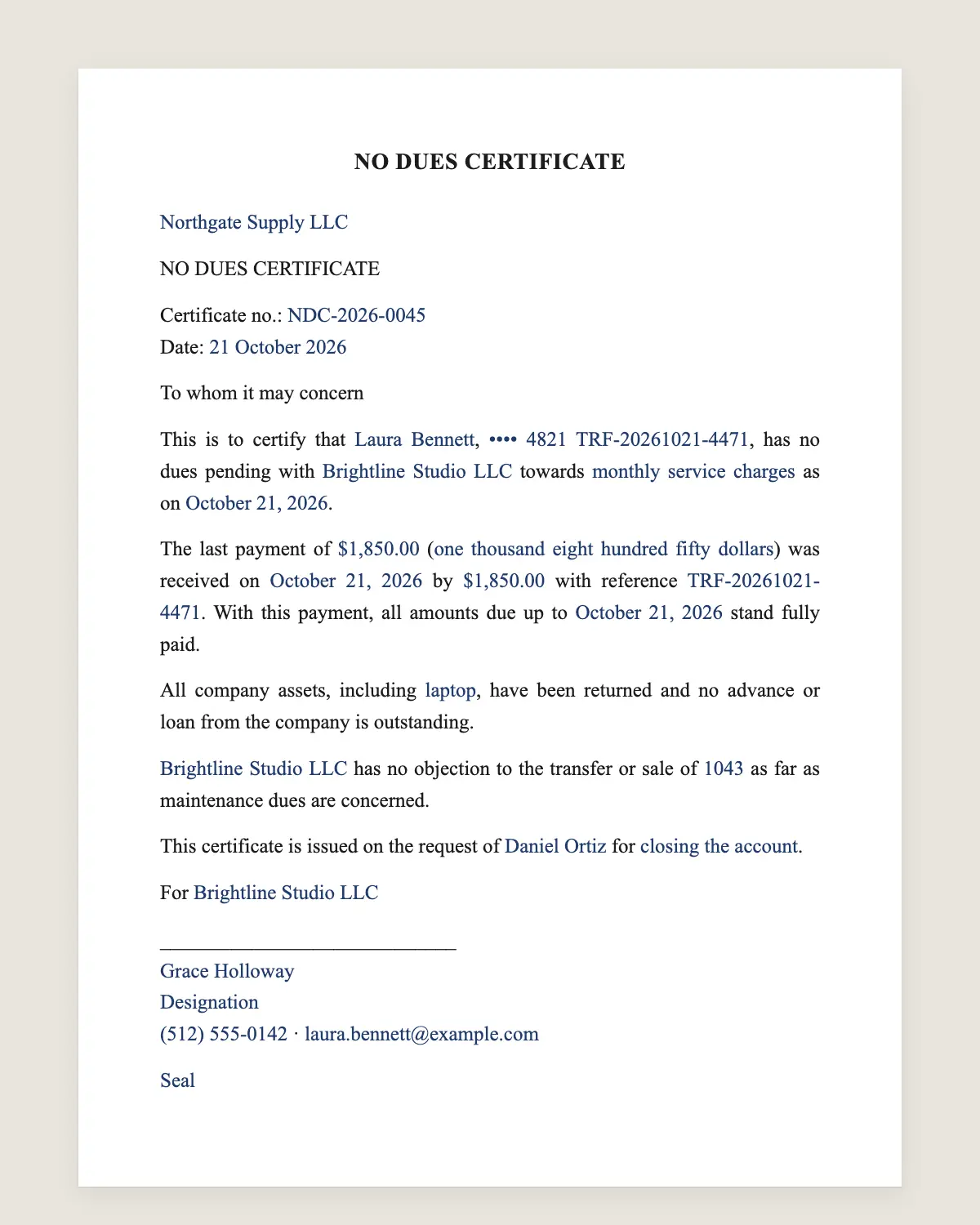
No dues certificate: full text
[Issuer letterhead]

NO DUES CERTIFICATE

Certificate no.: [NDC-2026-0045]
Date: [21 October 2026]

To whom it may concern

This is to certify that [full name of the person or business], [account no. / flat no. / student ID / employee ID] [reference], has no dues pending with [issuer name] towards [description of the dues, for example monthly service charges, rent of the premises at …, school fees, or advances and assets issued during employment] as on [cut-off date].

The last payment of [currency and amount] ([amount in words]) was received on [date of last payment] by [mode of payment] with reference [transaction reference]. With this payment, all amounts due up to [cut-off date] stand fully paid.

[Optional for employees] All company assets, including [laptop, ID card, keys], have been returned and no advance or loan from the company is outstanding.

[Optional for housing societies] [Issuer name] has no objection to the transfer or sale of [flat no.] as far as maintenance dues are concerned.

This certificate is issued on the request of [name] for [purpose, for example closing the account, vacating the premises, admission to another school or full and final settlement].

For [issuer name]

_____________________________
[Name of the authorised signatory]
[Designation]
[Phone] · [Email]

[Seal or stamp]
Versions by case
The certificate keeps the same structure in every case. Only the description of the dues and one optional paragraph change.
| Case | Who issues it | What the dues line says |
|---|---|---|
| Customer account | Supplier or service provider | Invoices and service charges up to the cut-off date |
| Tenant | Landlord or property manager | Rent, maintenance and utility bills |
| Student | School, college or coaching centre | Tuition, transport and exam fees |
| Housing society | Society secretary or treasurer | Maintenance, sinking fund and parking charges |
| Employee exit | Employer or HR | Advances, assets and any amount owed to the company |
What goes in each part
- Certificate number. Use a running number so you can find the certificate later.
- Reference. Write the account, flat, student or employee number. A name alone can be confused.
- Description of the dues. Say exactly what was owed. A vague line weakens the certificate.
- Cut-off date. The certificate covers dues up to this day and no later.
- Last payment. Amount, date, mode and reference. It shows how the balance reached zero.
- Purpose. Write why the person asked for it. Some offices only accept it for that purpose.
- Signature and designation. The person who signs must be able to confirm the accounts.
No dues form and no dues certificate
A no dues form is the internal checklist that leads to the certificate. Each department signs that nothing is pending.
Accounts confirms payments. The library or stores confirm returned items. HR confirms advances. Once every line is signed, the issuer prints the certificate on letterhead.
| Department | What it checks | Signed by |
|---|---|---|
| Accounts | No invoice, fee or advance pending | [Name] |
| Stores or assets | Equipment and keys returned | [Name] |
| Library | Books returned and fines paid | [Name] |
| Administration | ID card and access returned | [Name] |
When a no dues certificate is asked for
- A customer closes an account and wants proof that it ended clean.
- A tenant vacates and needs it to get the security deposit back.
- A student moves school and the new school asks for it with the transfer certificate.
- A flat owner sells and the buyer asks for the society's no dues.
- An employee exits and full and final settlement waits for it.
Common mistakes
- Issuing it before the last payment clears. Wait until the money is in the account.
- Leaving out the cut-off date. Without it the certificate seems to cover future dues.
- Signing without checking the ledger. Pull the statement of account first.
- Using plain paper for an official purpose. Print it on letterhead with a seal if you have one.
How to request a no dues certificate
Ask the issuer in writing and give them what they need to check the account. A short message is enough.
- Pay any pending amount and keep the payment reference.
- Write to the accounts team with your name, account or flat number and the purpose of the certificate.
- Attach the last payment receipt and, for employees, the asset handover form.
- Ask for the certificate on letterhead, signed and dated.
- Keep a scanned copy and the original together.
Sample request. “Dear Sir or Madam, I have paid all dues up to [date] for account [number]. Please issue a no dues certificate for [purpose]. The last payment reference is [reference]. Regards, [name].”
Keep every account at zero dues
A no dues certificate is easy when the ledger is current. Makatea sends each customer a WhatsApp reminder before the due date and records every payment.
When someone asks for the certificate, the balance is already in front of you. Start free for 14 days with no card.
Free on Makatea: proforma invoice template · promissory note template · rent receipt template · free receipt template
Frequently asked questions
What is a no dues certificate?
It is a letter that confirms nothing is owed to the issuer up to a given date. It is signed by someone who can confirm the accounts.
Who issues a no dues certificate?
The party that was owed. A supplier, landlord, school, housing society or employer issues it.
Does a no dues certificate need a stamp?
Not always. Many offices accept it on letterhead with a signature. A seal adds weight when the issuer has one.
Is a no dues certificate the same as a NOC?
No. A NOC says the issuer has no objection to an action. A no dues certificate says nothing is owed. Some housing societies combine both.
Can I issue it in English?
Yes. English is accepted across India for this certificate.
Do I need an account to download the format?
No. The Word file downloads directly with no sign-up.
Your recurring collections on autopilot
Makatea sends the reminders over WhatsApp and email, records every payment and tells you who to follow up with first.
14 days free · No card
Keep reading
Statement of account template in Excel and Word
Download a free statement of account template in Excel or Word, no signup. The running balance and the amount due calculate as you type, ready to send.
Payment agreement letter template in Word
Download a free payment agreement letter in Word, no signup. Set the balance, the installment dates and what happens if a payment is missed.
8 payment reminder messages for every due date
Copy 8 polite payment reminder messages for WhatsApp and SMS, one for each day around the due date. Free to use, with what not to write in each one.
Billing software that reminds your customers on WhatsApp before the due date
Makatea reminds each customer on WhatsApp and email before the due date and records every payment. Upload your Excel and try it free for 14 days, no card.
Proforma invoice template
Fill in a proforma invoice online and download it as PDF or as an image for WhatsApp. What it is, what it must show and how it differs from an invoice.
Promissory note: what it is and how to write one
What a promissory note is, what it must include and how to write one, with an example. Fill in a free promissory note online and print it to sign.